Thursday, 4 May 2023

Mike Leigh's film 'Peterloo' 2018


DVD - 2019

Mike Leigh's movie - written and directed by him - was based on the Peterloo Massacre of 1819. It was screened at the 75th Venice International Film Festival and received its UK premiere on 17th October 2018 as part of the BFI London Film Festival, but in Manchester - the first time that the festival had held a premiere outside London. 

Economic grievances had brought into disrepute a political system which allowed and discouraged them. By the early 19th century, previous attempts at Reform having come to nothing, demands grew more radical. Moreover, during 1815 and 1816 the character of the movement for parliamentary reform changed. Through a lack of moderate leaders, extremists emerged - above all, the two great agitators, Henry (or 'Orator') Hunt and William Cobbett, made successful appeals to the masses. Hunt was the principal speaker at the first great mass meeting for parliamentary reform, held at Spa Fields in London in 1816. A huge crowd attended, and Hunt appeared preceded by two men, one carrying on a pike the red cap of the French Revolution, the other a tricolour, the flag of the future British republic. As a result, early in 1817, the government suspended Habeas Corpus, the Act which ensured arrested persons a trial.

Two years later, partly due to a falling off in trade, meetings were held in towns and on the moors in the North to demand reform. Among other demonstrations, a mass meeting was called in St. Peter's Fields, Manchester. Hunt was to be the main speaker. Some 6,000 assembled, bearing revolutionary slogans such as Reform - or Death. There was no disorder, but magistrates watching ordered troops in to arrest Hunt. These were impeded by the crowd. A detachment of the local mounted yeomanry rode in to support the soldiers. Eleven people were killed and over 400 injured. There was an outcry in the press, local and national. This did not stop the government from introducing the Six Acts later that year. Two of these restricted the freedom of the Press, and one the right of public meeting.

Did Leigh's film give an accurate account and did it get across the strong opinions shown in 1819? Yes, I think it did. The story focuses on both sides of the emerging conflict. Perhaps the aftermath of the Battle of Waterloo skimped rather on 'extras' (there were very few!) but it highlighted the PTSD of the young Joseph, who returns home in a zombie-like state. The problem for the viewer is that a traumatised state becomes rather boring. I knew what was going to happen to him, almost from the first. Death at Peterloo; so, the final graveside scene was somehow underwhelming. Joseph's home is a meagre dwelling, but with a caring and close-kit family, headed by Joshua and Nellie (Maxine Peake). The other son, Robert, the daughter Mary, and daughter-in-law Esther, all work in a cotton mill. The economic depression turns them against the Corn Laws and in favour of increasing radicalism. The men attend political meetings where local agitators, including John Knight (Philip Jackson - I thought I recognised the actor; he was Chief Inspector Japp in the long-running Poirot series!) rage against the system of government. The local authorities - a rum lot, possibly teetering on caricatures but I didn't need to be convinced (thank you William Cobbett!) - wait for an excuse to arrest the leaders. In London, the Home Secretary Lord Sidmouth ( Karl Johnson - again, memories of another TV series, Lark Rise to Candleford, kept jogging my mind) is determined to stamp out radical politics. When a potato is flung at the Prince Regent's coach (Tim McInnery - oh dear, a far cry from Black Adder's sylph-like figure as Lord Percy Percy and Captain Darling!), Sidmouth has the excuse to suspend habeus corpus.

Two of the local agitators travel to London to hear the famous Henry 'Orator' Hunt, who excels at the meeting but his vanity shows through afterwards (I thought Rory Kinnear was excellent as Hunt). Hunt agrees to travel to Manchester, but has to 'hide' in business Joseph Johnson's home until the Peter's Field meeting.  The film alternates between the gatherings of the marchers and the local magistrates' meetings. I thought this juxtaposition worked, as did the various speeches by local radicals. I read on the Amazon reviews that many thought these were too long and boring and there were two many characters! If you are used to watching the 20 second to one minute efforts on present Soaps, then you are not up to the intellectual effort or concentration needed. The irony is that we live in the age of the masses, for whom these early Radicals fought so bravely - many would turn in their graves.

Another criticism of the film was the paucity of the local militia and the regular army detachment sent in to disperse the mob and grab Hunt. Again, I thought Leigh used very effective camera angles to show the brutality against men, women and children - rather than worry about numbers of actors. The reporters present furiously return to their papers to expose the atrocity, coining a mocking name for it, The Massacre of Peterloo. Meanwhile, the Prince Regent sends his congratulations to the magistrates for suppressing radicalism and restoring 'tranquility'.


I 'bought' the film, and having read Cobbett, in both senses. I can see why it did not do particularly well at the 'box office'; but that's a reflection of the present day public rather than Leigh. I do agree, though, that it ended rather abruptly with too many questions left unanswered. Okay - we know Joseph died with others; but what happened to Hunt? how did the mill owner (shown apoplectic in one brief scene) deal with his returning workforce? were the local radical leaders punished? Mention of the Six Acts would have helped to ram home the fact that, in the short term, the radical movement had failed.

Monday, 1 May 2023

Nicholas Orme's 'Going to Church in Medieval England' 2022 Part I

Yale University Press first edition - 2022

This is a big book, almost hernia-inducing; but it is well worth persevering to the end. After the 406 pages of text, a further 77 follow with a List of Technical terms (a few of which I didn't know: e.g. commination - a service cursing evildoers; and hosel - communion in the form of holy bread); Endnotes - 47 pages of these; Bibliography; and Index.

A useful Foreword sets out Orme's canvas. The focus of the book is on people in church. It examines who organised the worship and religious affairs of a parish: the officiating clergy and the laity who assisted them. It describes the buildings to which people went, and the significance of their shapes and furnishings. It asks how far a parish church helped to mould its worshippers into a community, and how far other factors caused the community to divide into smaller groups. It tries to explore the extent to which parishioners went to church or did not go, what they experienced when they came, and how they behaved in church...

By about 1200 England possessed some 9,500 churches - either in the form of minsters, staffed by groups of clergy, or local parish churches, run by single clergy.  There was a significant increase in the latter after about 900, which came to be known as 'field churches'. Later these were outnumbered by chapels (after capella, borrowed from the church in France that took its name from its famous relic: the capella or cloak of St. Martin.) Being usually small in size, these chapels could be built on town gateways, on bridges and by ferries.

Bridge chapel at St. Ives

Chapter 2 deals with the Staff of the Church: parish clergy, whose basic word 'rector' meant one who had the absolute 'rule' of his parish, over both the cure of souls and benefice rights. His benefice and home were known as a rectory. An alternative word for him was persona, 'parson'. Deputy clerics were known as vicars. Below them were the chaplains (known in modern times as curates). An interesting section deals with the issue of celibacy, by no means universal in the Middle Ages, whether up front or clandestine. Then there were the deacons, parish clerks and other assistants - often young boys.

Chapter 3, on Church Building, details the point of, and use of, the chancel, nave, transept, vestry, porch and tower. I knew the background to most of this, if not the specific details. Why did churches face East? Whatever the original reason, it came to be rationalised as representing the place where the sun rises and where the earthly paradise lies. Jesus apparently ascended into heaven to the east of the disciples and would return to judge the world from that direction. For that reason Christians were buried facing east so as to rise before him when he arrived. Chancel is derived from cancellus, which means a screened off area. The author rather punctures the idea that most of the mini chapels in the nave and elsewhere were 'chantry chapels'. I didn't know that placing metal cockerel on the spire or roof symbolised watchfulness since such birds crowed in the night. Another interesting section deals with seating (or not) in churches. They seems to be allotted often to keep men and women in separate areas; seating was the invention of the laity, most likely for reasons of comfort and status.  A seat gave a distinct and reserved place in church which, if boarded in, might be warmer. As the popularity of seating grew, it was adaptable to the current understanding of social distinctions. Seating tended to make people's behaviour more uniform, and it eventually made possible the static services with their emphasis on teaching (preaching) that characterised the Reformation. One might summarise a church site as consisting of three zones. The churchyard was the frontier, which anyone might enter at any time. The next zone inwards, the nave, was holier than the churchyard...locked at night but open during the day. Further inside were the chapels and altars, still more restricted in access, and finally the chancel, the most sacred section. 

Chapter 4 concentrates on the Congregation.

The question of how many people attended church is almost impossible to answer. Not until the mid-19th century were anything like accurate figures recorded. It is clear from various accounts that many people refused to attend, quite apart from those who were unable to - such as those with ill-health, or those on the sea etc. Naturally, historians know more about the attendance of the better off. Orme has a fascinating section on (usually ill) behaviour. One's posture in church was one of standing, sitting, kneeling/bending the knee and, less often, lying prostrate. Praying with one's hands together may well have imitated the etiquette of feudalism. There were three main prayers by the early 13th century: the Paternoster (Lord's Prayer), the Apostles' Creed; and the Ave Maria. These three basic prayers formed one of the great continuities in Christian life from about the 1240s until the 1540s. The 'pair of beads' (later the 'rosary') came to consist of 55 beads on a string, made up of five groups of ten beads, each of which was a prompt to say the Ave Maria. Every ten of these was followed by a larger bead at which one said the Paternoster, and the Creed was pronounced when all the beads had been counted. Not being a Roman Catholic, I did not know this.

The 'pair of beads' or Rosary

Books/texts used included the Latin Psalter, the Hours of the Virgin (known as the 'matins book' or primer), as well as other liturgical matter. The Lollards were to bring alternative beliefs in an intellectual way to the forefront of debate after the early 1380. The document of 1395, now known as 'The Twelve Conclusions of the Lollards', struck at the heart of several Roman Catholic fundamentals - the denial of the Real Presence in the eucharist; no image veneration; priests could marry; the pope was Antichrist, and so on.

I have now reached page 197 out of 406 pages of text; virtually halfway. A break is needed, simply because the sheer mass of information becomes too much to assimilate in any meaningful way. Orme has delivered a tour de force which is invaluable for coming to grips with the material. His intense sympathy - almost empathy - for his subject is clear and the wealth of his research is made understandable due to his ease of description. I will return, but not just yet!

Saturday, 29 April 2023

Trois-Etoiles' 'The Member for Paris' 1871


Smith, Elder first edition - 1871

The story of this author's life is at least as interesting as his literary output. Trois-Etoiles was the pseudonym for Eustace Clare Grenville Murray (1819 or 1824 - 20th December 1881). Murray was the illegitimate son of Richard Grenville, 1st Duke of Buckingham and Chandos. He matriculated from Magdalen Hall, Oxford in March 1848 (a tumultuous year across Europe) and joined the Inner Temple as a student in 1850. He was appointed to the diplomatic service by Lord Palmerston. and was sent as an attaché to the British Embassy in Vienna in July 1851. He was recalled from Vienna for doubling as foreign correspondent for the Morning Post on the side. In October 1852, he was appointed fifth paid attaché at Constantinople, However, he failed to get on with the irascible Stratford Canning, and was shipped to Mitylene (Lesbos) as vice-consul. He caricatured Canning in his "Roving Englishman" sketches in Household Words as Sir Hector Stubble. Murray was moved yet again, this time shipped to Odessa as consul-general in 1858. For over ten years he engaged in feuds with English merchants from whom he claimed fees they wouldn't pay. Lord Derby ruled against Murray, who came home to England and subsequently attacked Derby at every turn. 

Stratford Canning

As editor of The Queen's Messenger, a bitterly satirical journal of the day, (referred to as polemical, personal, unfair and disrespectful) he wrote an article, Bob Coachington Lord Jarvey, which was considered by the present Lord Carington to cast aspersions on his deceased father. In 1869, Carington horsewhipped Murray outside the Conservative Club. Court cases followed which ended with Murray fleeing to Paris for good. He became well known in Paris as the Comte de Rethel d'Aragon, using the title of the Spanish lady whom he had married. He wrote innumerable sketches and essays for the American and English papers. He was best at short satirical pieces, incisive in style and caustic in matter. He was Paris correspondent for the Pall Mall Gazette and the Daily News, also writing for the Cornhill and the Illustrated London News. He was adept at circulating private gossip, mainly by the use of hint and innuendo. He died at Passy in 1881 and was buried in Paris.

The Member for Paris commences in 1854, when Hautbourg on the Loire was fallen of a sudden from its snug position of ease into penury...the Hautbourg of 1854 was but the ghost of the Hautbourg of 1851. The reason? The Duke of Hautbourg, being in Paris at the time of monsieur Napoleon's coup-d'état, finding himself face to face with a troop of government horse and trying to escape, was slain. The irony was that he was a conservative Legitimist; worse, he was found lying side by side with a subversive sweep, a costermonger of socialist tendencies, and a small boy, three foot high, holding a red toy-flag emblazoned with the heinous words, Vive la Liberté! Much of the three-decker novel continues in this vein - ironic, often caustic, humour which actually adds to the pleasure of turning its pages. The new Duke, unlike his deceased nephew, is a Radical who foreswears his title and is known to all as Monsieur Manuel Gerold. A dedicated Republican, Gerold had gone into voluntary exile in Brussels, a hive of French republican emigrés. Gerold has two sons, 24 year-old Horace and Emile, a couple of years his junior. He hands over his entire estate to the young men, saying it is up to them what they do with the title, lands and revenues (unfortunately much of it revivified by profits from slavery).

The story unfolds slowly (although it takes place over very few years) as the brothers diverge in their attitudes as to how best to serve republicanism and their father. They install themselves in a third floor rented accommodation in Paris' "Latin Quarter" close to the Panthéon. They both study for the law and become barristers.  Murray (as we shall call the author) creates a marvellous family group out of the Pochemolles: the landlord, M. Pochemolle was a valiant conservative of existing institutions, whatever they were (who found it appalling that the brothers had a picture of the famous Tennis Court gathering against Louis XVI); Mdme. Pochemolle, stout, buxom and like any Jane Austen mother, determined to get the best match for her daughter; the son M. Alcibiade Pochemolle, who allows the author to construct one of the most droll chapters. Inter Pocula, when he gets drunk and spills all the family's beans to Horace. At a breakfast, he fell to on the omelette and remarked perplexedly on the giddying properties of fresh air, which had almost knocked him off his chair just now; the daughter, Mdlle. Georgette, who looked some seventeen springs old, and was as pretty as clear hazel eyes, thick chestnut curls, red lips, and neat dressing could make her... soon falls in love with Horace, who takes far too long to realise this. Only in the latter part of Volume III, does he reciprocate the feelings. Too late, he is now married and in a touching scene near the end of the book, her better conscience overrides his. 

One of the dominant characters throughout the story is M. Macrobe - who at first sight looked like a weasel, upon closer inspection like a badger, and who, after mature examination, left one doubtful as to whether there were not a chimpanzee or two amongst his ancestors... His nefarious dealings, particularly with his highly suspect Crédit Parisien, reminded me a little of Anthony Trollope's Augustus Melmotte in his The Way We Live Now, published in 1875, four years after Murray's novel. It is his Macrobe's daughter, Mdlle Angélique - a blue-eyed, blonde-haired, angel-faced child, who looked at people with a perpetual expression of soft wonder - who Horace marries. She is the tragic character in the play - her father uses her to get in with Horace, the new Duke after his father's death in Brussels, and the latter marries her for his own political reasons. He is not in love with her and the decline in her mental health as she comes to realise this is sensitively written. 

The author clearly has no time for Napoleon III or his Second Empire - the Paris of the Second Empire was there, a throng of senators, ministers, deputies, stock-jobbers, patchouli-novelists, eau-de-rose journalists; not only is the Emperor portrayed as a dictator but  his main henchman, M. Gribaud, an oily, two-faced, bully of a man, is venomously attacked. The policeman, M. Louchard, well-versed in  government corruption and regularly used by Gribaud and Macrobe, is another believable character, with his false beard and fake eyeglasses enabling him to spy on Horace and others. Murray pours scorn on French newspapers - those spicy collections of false news, mad leaders and improper anecdotes - which was a bit rich considering his own involvement in such a trade. The English journalist, Monsieur Drydust, was surely based on the author or is a compendium of those he knew. The Prince of Arcola, with his English valet Bateson (a touch of Jeeves?) and his Anglophile approach to life is perhaps - with Emile Gerold, Georgette and Angélique - one of the four who deserve a berth in Heaven. Horace, on the other hand like most ambitious men, whose range of mind is not extensive, is fatally flawed.

There are many humorous touches throughout.  I liked this comment on  Father Glabre's "Confession Mornings" - it is to be supposed that the male element in the St. Hyacinth congregation were either singularly free from human error or lamentably blind to their own short-comings, or painfully remiss in their religious duties; anyhow no trowsered penitent was ever seen to kneel in Father Glabre's confessional and declare him himself a miserable sinner. But the women made up for this. What a throng, and what devotion! What a rustling of silk dresses, what contrite rows of six-buttoned gloves clasped daintily over velvet missals... And, to cap it, Father Glabre is clearly more worried about his shares in the Crédit Parisien than any heavenly reward.

I was not anticipating the tragic end - one of the deaths, sadly yes; but not the other. Perhaps it was fitting, but it would have left much heartache behind.

Monday, 24 April 2023

T.L. Crosby's 'The Two Mr. Gladstones' 1997


Yale University Press first edition - 1997

Although I have read Roy Jenkins' magisterial biography of Gladstone, I found this slighter work fascinating. On the dust wrapper flaps of Travis Crosby's work, it reads: this book applies an eclectic and sophisticated psychological framework to Gladstone's life that explains the duality of his character. Whilst I wouldn't go so far as that, Crosby has certainly provided much food for thought. He goes on: the book describes his childhood and adolescence, his marriage, his rise to prominence as a young Conservative member of Parliament, the temporary languishing of his political career at midcentury, his leadership of the Liberal Party, and his accomplishments in domestic and foreign affairs as prime minister. Crosby traces the disparate threads of Gladstone's volatile personality and shows how he developed a range of responses to emotional stress to shore up his need for an unquestioned control over the events of his life. Gladstone emerges as a man who wrestled with powerful internal conflicts as much as he struggled with the formidable political and social issues of his time.

Three points in particular stood out for me: firstly, Crosby's repeated argument that Gladstone needed to feel in control - at home, in Cabinet and Parliament and in governmental policy. Secondly, just how 'up and down' he was in his temper and temperament (it reminded me a little of Gordon Brown!); and thirdly, I didn't realise just how long he was in the relative political wilderness in his middle years.

Gladstone's attitude to the religious apostasy of his friends James Hope and Henry (later Cardinal) Manning was typical. He saw it as an intolerable threat to his perception of himself as the upholder of religious constancy...the Church of England represented order, an ethical system, and a certain and regulated set of rules for behaviour...for Gladstone, religion was the ultimate source of his belief in an orderly system in the midst of a disorderly world. A threat or shift in his religious beliefs was a threat to his psychological well-being and to his coherent view of life. It all contributed to his sense of spiritual malaise during the late 1840s and early 1850s. Another interesting point that Crosby makes is that Gladstone, as a firm Evangelical believer, had a keen sense of personal unworthiness joined to a highly developed self-righteousness. This was a characteristic often seen as arrogance in his later life.

Travis suggests that the two options open to Gladstone, when failing to get his way, was either to go on the attack or to 'retreat' (usually to Hawarden or abroad). One can see this in his long tussle over Ireland - e.g. his change from conciliarism to coercion in the early 1880s. A great cause could subsume all other, less important issues and could promote the coherence he sought both politically and personally. D.A. Hamer (1972) says this explains Gladstone's propensity for finding "missions": his "concentration, the intensity with which it was organised, and the rhetorical power with which he presented it to others" can be seen as a conflict between his "extremely emotional and excitable temperament" and his "ceaseless striving to organise, systematise, and order the diverse materials of his existence". 

Travis ends his book with a look at what other Historians have written and it is worth quoting the passage:
In Gladstone's own time, loyal friends and political foes alike, while acknowledging his intelligence, devotion to duty, and moral concerns, questioned his judgement, character, and mental stability. Historians and other scholars of the twentieth century have followed these cues. John Vincent believes that Gladstone had a "pathological lack of self-control"....Jonathan Parry condemns Gladstone's "manic frustration" and "obsession with power". To Parry, Gladstone "seemed to lack the character, tact and temper necessary to lead a party responsibly"...Michael Winstanley thought especially harmful was Gladstone's "personal", "hopeless", and "destructive obsession" with Ireland.


Crosby suggests that the apparent discords of Gladstone's outward life can best be seen as a consistent effort on his part to maintain within himself a stable and coherent psychological state. His Diaries reveal that struggle between his inward and outward lives - between the two Mr. Gladstones. One must remember that he was four times Prime Minister and at the end of his life was known as the 'People's William' and G O M - the Grand Old Man (or to his political rivals 'God's Only Mistake').

Thursday, 20 April 2023

G.P.R. James' 'The Smuggler: A Tale' 1845


Smith, Elder and Co. first edition - 1845

G.P.R. James had taken up a house in Upper Walmer, Kent - some quarter of a mile from the sea - in the spring of 1841. Towards the end of 1843, he moved to another abode, a mile or so away, called The Oaks, close to Upper Deal Church. Here he wrote, among other novels, Agincourt and Arabella (1844) and The Smuggler (1845). I have all three in three-decker first editions, with Arabella still to read. 

When James wrote The Smuggler, reminiscences of the smuggling age were yet fresh, with many an elderly hearty ready to tell wonderful, if occasionally exaggerated, stories of bygone years.  James, ideally placed at Walmer and Upper Deal, will have heard at first hand such stories and was able to weave into his tale the exploits of the Ransley Gang (whom he styles 'Ramley'). The geographical position, its local features, its variety of coast, all afforded the county of Kent the greatest advantages - the fine level of the Marsh, Sandwich Flats and Pevensey Bay presented harbours of refuge and places of hiding for the kegs and bales. Moreover, the interior of the county - large masses of wood, numerous gentlemen's parks, hills and dales, roads only fit for horses or men on foot - offered the land smugglers the secrecy and safety no other county afforded.`

The story of Smuggling in east Kent in the 1820s is dominated by the Blues (supposedly due to them wearing blue smocks to work), who were a gang based in Aldington and who worked the area between Rye and Deal. The nucleus of the group came from that village and picked up support from a larger area. From Sandgate to Dungeness, and in every town in the Marsh there were confederates and hiding places. They were engaged constantly in conflicts with revenue officers as well as with the dragoons who finally were employed to put an end to smuggling. The cargoes were usually tobacco, spirits and salt. On arrival, the land party of 250 or so usually formed a corridor of armed men stretching about 40 yards inland. Protected by this cordon, the contraband was moved quickly.  Prominent in such smuggling was George Ransley and his family. They were from Ruckinge and were originally farmers and waggoners. Profits from smuggling paid for his house at Aldington, the unlicensed Bourne Tap. The gang were renowned for their violence. Ransley organised his business methodically and professionally. He kept a surgeon, Dr Ralph Papworth Hougham, to attend to wounded smugglers; his solicitors in Ashford, Langham and Platt, defended him when necessary in court. At Aldington, the gang used the Walnut Tree as their H.Q., but he also profited from the sale of smuggled liquor from the Bourne Tap.


Ransley's long career ended at his home 'one stormy night' (shades of G.P.R. James!) in 1826. The authorities had finally had enough. A party of preventative authorities aided by a couple of Bow Street runners encircled the house and captured Ransley (who was in bed). A further 18 smugglers were also taken. They were all sentenced to death but the punishment was reduced to transportation. 

James weaves a credible and quite exciting story into the 'factual' aspects of the time. I think it is possibly one of his best tales. Each character stands up and is 'alive'. The two 'heroes' - Sir Henry Leyton and Sir Edward Digby are well-drawn and have quite distinct personalities; as do their two 'belles' - Edith Crowland and Zara Crowland. Moreover, the author's portrayal of the latters' father, Sir Robert Crowland, is realistically developed from a weak, pathetic figure into the man who comes good at the end, dying with a modicum of peace and happiness. His sister, Mrs [sic]  Barbara Crowland, could equally be found in the pages of Sir Walter Scott or Jane Austen. The younger brother, Zachary Crowland, was surely drawn from someone James knew, so well-rounded does he appear: there was nothing on earth which he considered so foolish as good-nature; and he was heartily ashamed of the large portion with which Heaven had endowed him. Richard Radford Snr. and Richard Radford Jnr., are more than arch typical 'baddies', with very differentiated personalities. As for the Ramleys (James merely changed two letters), that unsavoury family appeared drawn from real life. The two boys grew up into as fine, tall, handsome, dissolute blackguards as one could wish to look upon; and for the two girls, no term perhaps can be found in the classical authors of our language...they were two strapping wenches [with] the invincible arm of their mother.

The lesser characters - Jack Harding, the Widow Clare and her daughter Kate (whose tragic end veers on the right side of pathos), and the customs officer Mr Mowle, are also realistically delineated. The story of the latter's infiltration of the smugglers' gang may well have come from the real life events surrounding the [in]famous Battle of Brookland on 11 February 1821, where 4 smugglers  were killed and 16 seriously wounded, a midshipman James McKenzie was the only blockader to lose his life. Cephas Quested mistook one of the blockade officers, who was wearing a smock as a disguise, for one of the gang. Quested put a musket in his hand and ordered him to Blow some of the ---officers' brains out. This mistake cost him his life. Only Mr Warde (later unmasked as Mr Osborn, Harry Leyton's uncle) doesn't quite ring true.

My only irritation with the novel is something that James was well known for as a writer. His all too regular musings on 'aspects of life' in general, which serve to break up the flow of the narrative and rarely add anything of real value.  The very first paragraph in Volume One compares the improvements in clocks and watches during the last half century with society, which is but a clock, a very complicated piece of mechanism... The second volume  commences: What a varying thing is the stream of life! How it sparkles and glitters! Now it bounds along its pebbly bed, sometimes in sunshine, and sometimes in shade...Now it runs like a liquid diamond along the meadow; now it plunges in fume and fury over the rock...Oh dear!

First edition title page

I also have a lovely paperback edition in the famous Routledge Railway Library Sixpenny unabridged Novels series. The illustration on the front shows a sinister smuggler with a black eye patch - the 'Major' - who recognises the disguised  Customs Officer, Mowle. However, in recalling that the latter had 'saved' him at a magistrates' hearing, he allows him eventually to escape.

George Routledge and Sons paperback edition - 1887

I also referred to some of the books on Smuggling in my Library, in particular:

1909: Charles G. Harper  - The Smugglers (Chapman & Hall)
1959: Neville Williams - Contraband Cargoes. Seven Centuries of Smuggling (Longmans, Green)
1991: Richard Platt - The Ordnance Survey Guide to Smugglers' Britain (Cassell Publishers)
1999: Tom Quinn - Smugglers' Tales (David & Charles)


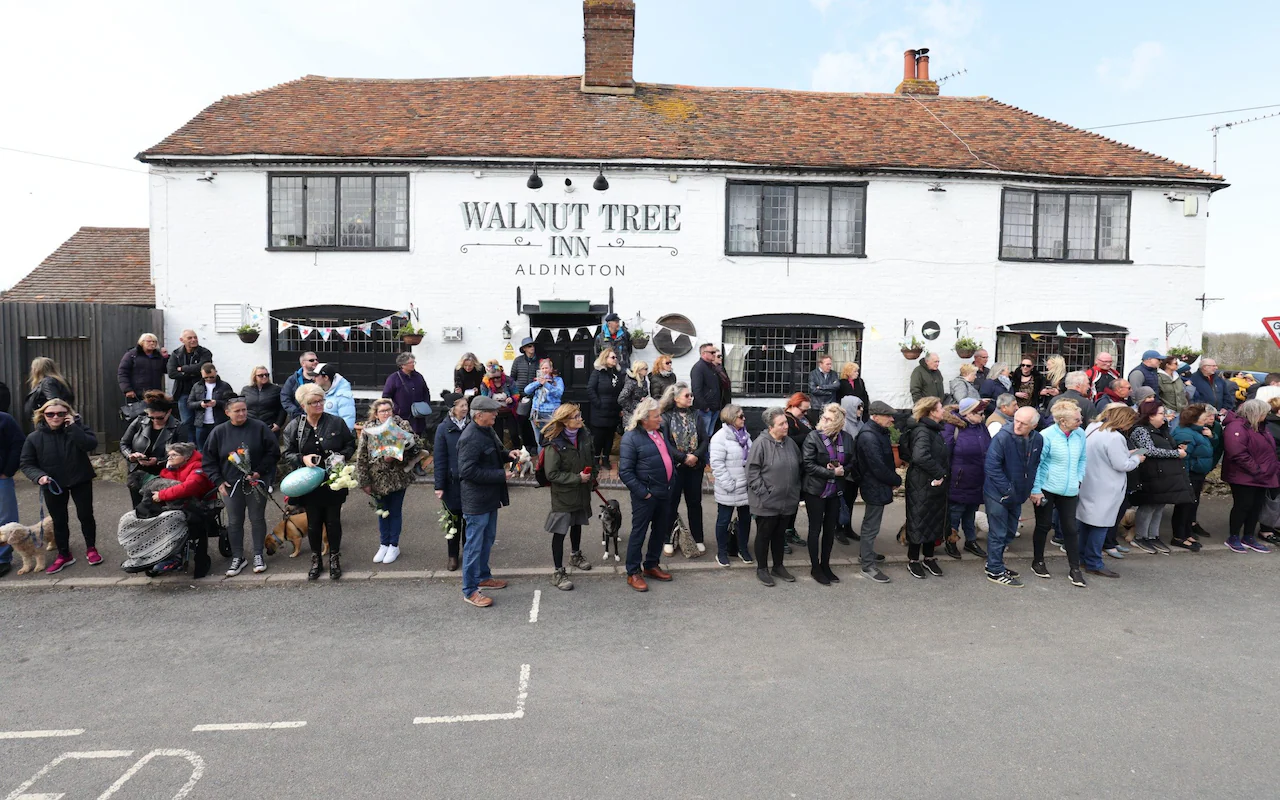
Amazingly, as I was putting the finishing touches to this Blog, I read the account of Paul O'Grady's (better known as the drag artist Lily Savage) funeral in his local village of Aldington. One of the photographs was of villagers lining the street outside none other than the Walnut Tree. I wonder how many in the crowd were descended from the Aldington Gang!

Friday, 14 April 2023

John Sweeney's 'Killer in the Kremlin' 2022

Penguin paperback first edition - 2023

What a gruesome story; what an evil man. No excuses - Putin is a narcissistic, psychopathic, sociopathic, plain evil creature. Sweeney's chapter headings chart the remorseless  path The Killing Machine - Rat Boy - Once and Future Spy - The Poisonings Begin - Mr Pleonexia (I had to look that up!) - The Underpants Poisoner - This Ends in Blood. Although this book might be regarded as a polemic, it is one that I totally subscribe to. 

John Sweeney calls himself an 'old school' reporter and says his philosophy is I poke crocodiles, if crocodiles they be, in the eye with a stick. He seems to have poked Putin in every orifice available; it's a wonder Sweeney is still alive, as his account of Putin's systematic murders/assassinations of those opposed to him stretches back to over a quarter of a century. Sweeney has gone undercover to Zimbabwe, Chechnya, twice, and North Korea. He upset Donald Trump by asking him about his links with the mob, and infuriated that sinister cult the Church of Scientology. An ideal man then for recounting Putin's unsavoury past, present and ? future.

What Sweeney has done for me, above all, is to link all those Putin involved 'episodes' together. I clearly recall reading about the bombing in Moscow in September 1999 - of two separate working-class blocks of flats - killing 222 men, women and children. Chechen terrorists? That was the official finding; more likely Putin's KGB (FSB now). Then the rash of poisonings of (sometimes potential) opponents:  Anatoly Sobchak, Putin's 'oldest friend' in politics, who died of a 'heart attack' in February 2000; Yury Shchekochikhin, a tough liberal democrat M.P., died in July 2003 due to 'toxic agents of an unknown origin'; Anna Politkovskaya, a forthright Russian journalist, gunned down by a lone assassin in her  Moscow apartment block in October 2006; Alexander 'Sasha' Litvinenko, dying in a London hospital, from drinking tea AND 26.5 microgrammes of Polonium-210; Boris Berezovsky, whose body was found by a bodyguard in a locked bathroom, with a ligature around his neck, in March 2013; Mikhail Khodorkovsky, once the richest man in Russia, sent to a Siberian labour camp; and his British lawyer Stephen Curtis, whose helicopter fell out of the sky approaching Bournemouth airport in March 2004 Worse was to come: an Air Malaysia Boeing flight MH17 over Eastern Ukraine was shot down on 17 July 2014 - by a Russian BUK surface-to-air missile. 298 people were killed. It emerged that it was downed by the Russian army. Putin, ever the narcissistic psychopath, denied involvement to Sweeney's face. The murders continued: on 27 February 2015, on a bridge one hundred yards from the Kremlin, Boris Nemstov - who nearly became leader instead of Putin and was now leader of the opposition -  was shot dead. Events came much closer home to the British, with the Salisbury poisonings of Sergei Skripal, once in the GRU Russian military intelligence, and his daughter Yulia. Sergei's 43-year-old son had already died of a 'mysterious' illness on a trip to St Petersburg in 2017. Sergei and his daughter survived but an unlucky woman, Dawn Sturgess, who ended up with a so-called perfume bottle, did not. The poison was Novichok. Then, in April, 2018 Maxim Borodin, a brilliant investigative journalist, fell off his balcony on the fifth floor of a Moscow apartment block. Official verdict - suicide. There have been several other 'falling out of a window' deaths in the last few years. And now we have that very brave (foolhardy?) opposition leader Alexei Navalny, who recovered from poison smeared on his underpants in August 2020, languishing in a Russian prison.

What rankles is that British politicians such as Peter Mandelson and George Osborne (as shadow chancellor) snuggled up to Oleg Deripaska, one of the very shady Russian businessmen. The Conservative Party certainly accepted 'Russian money' - Tories mentioned by Sweeney include John Whittingdale, Carrie  Symonds and Matthew Elliott. Boris Johnson's friendship with Evgeny Lebedev (now Baron Siberia - you couldn't make it up!), the son of a KGB colonel, is worthy of comment. Then there's Donald Trump! Sweeney writes: Was Trump the Kremlin candidate?...once in power, Trump did pretty much everything the Kremlin would have wanted him to do: sow division in NATO, weaken the European Union, kowtow to Putin.

And now (April 2023) it's the tragic plight of Ukraine and its people - being bombed to smithereens, murdered in cold blood, forcibly removed to Russia. Sweeney may be partially correct, when he calls the instigator of this inhuman crime (worthy of his predecessor Stalin) a fragile monster, but it is more blunt than that. Putin is purely a monster. Blood-soaked, evil, tyrannical, who is not fit to live.

Monday, 3 April 2023

Anthony Burton's 'William Cobbett: Englishman' 1997


Aurum Press first edition - 1997

In the middle of reading this biography, the latest Catalogue - number CCLXI - turned up from Jarndyce. These catalogues are collectors' pieces in their own right; this one was on The Romantic Background: Revolutionaries, Reactionaries, Radicals & Royals. It concentrates on items relating to the period roughly from 1790 to 1830 and, rightly, says in its Introduction, It was an extraordinarily fertile period in British literary history, and one in which writers, and poets in particular, engendered a new and more socially aware canon of writing. I looked for, and of course found, publications by and linked to William Cobbett. Items 434 to 485 relate to the man whom the compilers of the Catalogue say was a perennial thorn in the side of the establishment and who campaigned ceaselessly to expose corruption, to oppose abuses of power, and to champion the causes of the beleaguered and downtrodden. Ten other items for sale are also linked to Cobbett. I have purchased No. 472, the first edition of Cobbett's Legacy to Parsons, which queries their right to tithes etc, greater than the Dissenters have to the same? The copy will need 'work' on it, as the front board is partly detached. *

Cobbett's story is a fascinating one. As I read on, I found myself more and more impressed with his determination and staying power. He must have been nearly impossible to live with, and one's heart goes out to his long-suffering spouse Anne (Nancy). He met her in St. John, New Brunswick, where her father was an artillery sergeant. She was a tiny creature, just four feet two inches tall and only thirteen years old, but he decided at once that she should be his wife. She was beautiful, which to Cobbett was an 'indispensable qualification'. Thus, at least one good came out of Canada, which Cobbett described as 'the offal' compared with the USA which was the 'sir-loins'. That was in 1785. Back in England, they were married in 1792. She stuck the life with him until 1827, when she attempted suicide. Cobbett's relations with her never really recovered and, as he grew more paranoid in old age, they were barely on speaking terms. Tragically, on his death bed, she had to wait until he had lost consciousness before she was allowed into the room. 

Modesty was never a part of Cobbett's nature. Too true! You were right if you agreed with him; simply wrong if you disagreed. His life is littered with argument, invective, fallings-out with former allies, and rarely with magnanimity. He hated William Pitt, George Canning, and Viscount Castlereagh; despised Sir Francis Burdett (whom he saw as a turn coat); alternated between praise and scorn for Thomas Paine (he brought his body/bones back to England for reburial!); but was a cheer leader for the 'wronged' Queen Caroline. He had to escape abroad to the United States on two occasions; he was imprisoned in Newgate from 1810 to 1812 (Anne was pregnant again and debts were mounting, but she stood by him).

He was born a century too early, as few in power and authority shared his views. He increasingly saw it as his purpose on earth to be the champion for the poor - rather like Gladstone, he moved from being a reactionary to a radical, although the former never moved to the extremes that Cobbett did. Cobbett's great weapon was his ability to convey his views in print - his Rural Rides may have been his best work (the one which is probably his most known today), but from his first appearance in print - as Peter Porcupine in the United States, a stream of writing - newspapers ( the Register, Cobbett's Evening Post etc.), tracts, manuals, travel books and letters kept him at the forefront of political and social affairs. He ranted against Rotten Boroughs (Old Sarum was the accursed hill) and the Church of England and its clergy, particularly the hierarchy, homing on on the iniquity of tithe gathering. He loathed Methodists - who preached servility on earth, with the promise of rewards in heaven. He was apoplectic over Peterloo 'massacre'

One of  Burton's chapters is entitled The Angry Man - it could well sum up Cobbett's entire life! He had much to be angry about and did his best to ensure his readers knew about real poverty not just the abstract idea. He crossed literary swords with Rev. Thomas Malthus - poverty was not the end result of a natural law. It was due to particular actions taken by specific men, and these actions could be changed...he dreamed of his perfect land: he fought all his life for justice for the poor.

Another biography, which I have, by Daniel Green - which has as its subtitle The Noblest Agitator - puts on the back flap of its dust wrapper: He was  moralistic, dogmatic, pugnacious, prejudiced, scurrilous, and deeply compassionate, and as much of a humbug as any other successful agitator, for all his belief in his own absolute rectitude. Spot on!

Hodder and Stoughton first edition - 1983


I saw great Cobbett riding
The Horseman of the shires;
And his face was red with judgement
And the light of Luddite fires.
G.K. Chesterton: The Old Song

*It has gone off to my favourite, and extremely skilful, bookbinder. I look forward to reading it in a pristine state when it returns.