Sunday, 19 November 2023

Caroline Young's 'Roman Holiday. The Secret Life of Hollywood in Rome 2018


The History Press first edition - 2018

Having recently watched Audrey Hepburn and Gregory Peck in that delightful 'Roman Holiday', the cover on this book caught my eye and I purchased it via a remainder online firm.

The author heads each chapter with the single Christian name of the actress (they are all actresses apart from chapters 2 and 18, which are headed Tennessee [Williams] and Richard [Burton]).  I had heard of all of them apart from Anna Magnani, Italy's most enigmatic movie star, providing hope and inspiration through her strong, heartfelt performances at the tail end of the war. In fact, the whole period between 1945 and 1960 seemed to be an attempt at a joyous, almost dreamlike, escape from the horrors of the second great and awful conflict of the first half of the 20th century. Rather like the hedonistic days in the London and Paris after the Great War, the goings-on in the famous Via Veneto were focused on live for the day, with lashings of booze, drugs, tobacco and sex, supported by an almost unimaginable effulgence of wealth. Authors such as Tennessee Williams, Truman Capote and Gore Vidal mixed with the actors and directors

The actresses seem to appear on the pages, and in Rome, on a never-ending conveyor belt. I warmed to a few and recoiled from others. The gamine, fresh-faced Hepburn would still be at the top of my tree, notwithstanding her questionable taste in men - the wooden, controlling Mel Ferrer, the playboy Andrea Dotti. There is something about the earthy Anna Magnani - who was named as Best International Actress at the Venice Film Festival in 1947 - which attracted rather than repelled me. A regular sight on the Via Veneto, speeding along in her green Fiat station wagon, hopping into the bars dressed casually in black slacks, with uncombed hair and accompanied by her white poodle, Pipo, and black German Shepherd, Micia. Ingrid Bergman's life-changing decision to leave her husband for Roberto Rossellini, led her to Rome and Italy. One of Hollywood's biggest stars, she was considered a natural, wholesome actress and a devoted wife and mother. That image came crashing down when she departed Hollywood for Rossellini, another control freak. She became the Scarlet Woman.

A young Italian, Sofia Scicolone, whose mother Romilda regularly took to the Cinecittà gates looking for work as an extra in the movies, finally got the part of a Christian slave girl for one day's filming in Quo Vadis in 1950.  Her name was changed to Sofia Lazzaro, as it was thought to be more exotic. Gracing cover pages of magazines, coming second in the Miss Italy competition in 1950, she caught the eye of the producer Carlo Ponti. From then on her career was assured and she also became the 'wife' of Ponti. By now, she had changed her name yet again - to Sophia Loren. Later chapters tell the stories of Ava Gardner (1966 The Bible, In the Beginning), Anita Ekberg (1960 La Dolce Vita), Brigitte Bardot (1956 Helen of Troy)  and Jane Fonda (1967 Barbarella). Perhaps the most famous couple were Elizabeth Taylor and Richard Burton and the most [in]famous movie being Cleopatra (1963). The film's production resembled something like a huge thousand-man circus coming to town...there were 90 Americans, 350 Italians and 16 Britons hired on the crew... Burton exuded confidence, personality and sex appeal. Yet, behind this glamour lay an alcoholic, whose drinking became prodigious. Taylor was not that far behind. The best assessment of their tempestuous time together can be summed up as they deserved each other. In some ways, I found them the least attractive of a pretty unattractive bunch.

Apart from Gregory Peck, it is the men who come across as bounders, as hangers-on, as control freaks and, often, less talented than their partners. One has to give Benito Mussolini credit for introducing the first Venice Film Festival in 1932 and opening Cinecittà (cinema city) in 1937. The early films - Roberto Rossellini's Rome, Open City(1945), Vittorio De Sica's The Bicycle Thief (1948) - were followed by Joseph Mankiewicz's The Barefoot Contessa (1954) and Federico Fellini's La Dolce Vita (1960)

Caroline Young is very good at describing the fast-moving, over-the-top luxury times, centred on Rome in the two decades after the War. Her grammar occasionally jars and there are one or two typos which should have been spotted by a more careful editor or proof reader. Her Prologue gives a good summary of Rome in the 1950s, from the point of view of the movie industry and its stars:

So here you would find Ingrid Bergman, under self-imposed exile after coming to Rome for love; Audrey Hepburn, who represented joyful holidays in the city in the early 1950s; Ava Gardner, whose tempestuous love life and appreciation of the nightlife always served for a good photo; Elizabeth Taylor, the queen of Hollywood excess and jet-set lifestyle; and Anita Ekberg, the face and body of la dolce vita. Sophia Loren was the home-grown star who captivated Hollywood and who represented the struggles and dream of young girls who survived the Second World War and lived through Rome's 1950s recovery, and Anna Magnani, the icon of Italian neorealism and one of the most admired, revered women in the country.

All now gone (well, not quite)

DEATHS:
September 1973 - Anna Magnani
August 1982 - Ingrid Bergman
[August 1984 - Richard Burton]
January 1990 - Ava Gardner
January 1993 - Audrey Hepburn
March 2011 - Elizabeth Taylor
January 2015 - Anita Ekberg

Sophia Loren is still alive at the grand age of 89.

I am not sure why Gina Lollobrigida (July 1927 - January 2023) - dubbed 'the most beautiful woman in the world', who died aged 95, was not mentioned in the book. Still alive in 2018, when the book was published, perhaps she forbade her inclusion?

Thursday, 16 November 2023

Walter Scott's 'Waverley' 1814


Archibald Constable third edition - 1814

At last, I can truly say I have read every volume of Walter Scott's 'Waverley' novels, which stretched from 1814 to 1832. The saying that 'the first shall be last' is proven correct, as reading Waverley brings to an end my marathon journey, which began in January 2020 with Guy Mannering. I read them in chronological order. Why leave Waverley to the end? simply - cost. I now have every single (or triple!) Scott novel in first edition, a few in the original publishers' boards. However, Waverley was the one out of reach of my pocket. I have just looked up the price of first editions on the Internet: there are six copies and they range from £8,251 down to £3,553. I had to settle for a fine third edition, which cost me £206 (including postage).

The novel was probably started in 1808 (Scott gives conflicting versions of the date). He had completed seven chapters but, on showing it to a few friends who unanimously condemned it, he put it aside. When he finally returned to it, he wrote the last two volumes in three weeks. Why had Scott waited so long? Possibly due to the comparatively low prestige of the novel at that time and partly that verse was still regarded the natural medium for narrative. Waverley was a conspicuous success. One reader wrote,
no work that has appeared in my time made such an instant and universal impression...The unexpected newness of the thing, the profusion of original characters, the Scotch language, Scotch men and women, the simplicity of the writing, and the graphic force of the descriptions, all struck us with an electric shock of delight... There was no surprise in its appeal to a reading public becoming bored with Gothic terrors.

The story of the young Edward Waverley, neglected by an ambitious, political father and brought up by a rich, elderly uncle with Jacobite leanings, is that of one drawn to romance through his reading. Although Waverley joins a government regiment in Scotland, he and the novel only really come alive with his visit to his uncle's friend, the Baron of Bradwardine. The latter runs his estate of Tully-Veolan at the foot of the Highlands as a feudal lord, even keeping a Shakespearean fool, Davie Gellatly. Romance follows romance, when Waverley visits the nearby clan Mac-Ivor at Glennaquoich and is dominated by the energy of the patriarchal Fergus and his sister Flora, both fanatically wedded to the Jacobite cause. Bonny Prince Charlie has landed and Fergus, the Baron and others sweep Waverley into the Rebellion.  Waverley knows in his heart the cause is hopeless, but the personal charm of the Prince, the dominating Fergus, his love for Flora, all propel him into the ranks of the Jacobite invasion of England. At Prestonpans he saves the life of an English officer and ensures his paroled release to his sick wife back in England. Luckily, the officer Colonel Talbot is able to return the favour and gains Waverley a pardon. Fergus is executed at Carlisle, Flora enters a French convent, and Waverley marries Rose Bradwardine to live happily ever after. His future was accurately prophesied by Flora: a quiet circle of domestic happiness, lettered indolence, and elegant enjoyment of Waverley-Honour, his uncle's estate.

Waverley has all the positive aspects of a Scott novel - character drawing, landscape depiction - with much of the later negative traits kept to a minimum. Two things which personally irritated me throughout the Waverley series, scarcely intrude. Firstly, the placing of (often trite) extracts from others' works, prose or poetic, at the beginning of a chapter, pleasingly does not occur until Chapter XVII (p. 266) of the 3rd Volume - there it is from Shakespeare. This continues until Chapter XXIII. I have felt that often a gobbet from an 'Old Song' or 'Old Tale', have actually been Scott's own material. Secondly, the 'phantom' or 'spirit' of another world only appears to Fergus as the Bodach Glas. The early 19th century is now 200 years gone and the early 21st has very little time for such nonsense, although it is worrying to see Halloween taking over from Guy Fawkes Night these days. I suppose I could add a third positive point - Waverley is blessedly free from the regular infusion of Scott's verse which can so break up the narrative flow in the author's later novels.

Waverley was criticised for its overlong and slow-moving start - the period before Waverley leaves for his regiment. In J.G. Lockhart's Memoirs of Scott, he quotes his father-in-law's claim that he had left the story to flag in the first volume on purpose...to avoid the  usual error of novel writers, whose first volume is usually the best. Scott argued in Waverley that the course of Narrative has the earlier events are studiously dwelt upon, that you, kind reader, may be introduced to the characters rather by narrative, than by the duller medium of direct description; but when the story draws near its close, we hurry over the circumstances, however important, which your imagination must have forestalled, and leave you to suppose those things, which it would be abusing your patience to narrate at length.

In his Preface to the Third Edition, the author rebuts the accusation that his portrayal of Callum Beg (Fergus' rapscallion servant) bore hardily upon the Highlanders' national character. Nothing could be further from his wish or intention. The character of Callum Beg is that of a spirit naturally turned to daring evil, and determined, by the circumstances of his situation, to a particular species of mischief. 
It is perhaps apt to read, on the penultimate page of the last volume, his praise of Elizabeth Hamilton's Glenburnie (her genius is highly creditable to her country), another work roundly criticised for its portrayal of Highland life and people. 

Saturday, 4 November 2023

Clare Pettitt's 'Dr Livingstone, I presume?' 2007


Profile Books first edition - 2007

The meeting, in late 1871, between Henry Morton Stanley and Dr. David Livingstone in what is now Tanzania, in East Africa, is one of the most famous in history. An episode of the TV soap ER is called Dr Carter, I presume? and an episode of Star Trek is entitled Dr Bashir, I presume? Clare Pettitt's book, although rather repetitive on occasions, due to the way she has subdivided it, enables the reader to get a pretty good idea of the characters, warts and all, of the two main protagonists and the forbidding Dark Continent. She is correct in arguing that it was Stanley who ensured Livingstone would be remembered as more than just yet another European explorer. And explorer, rather than missionary, he was.

The book is very much of its time - the early 21st century. One written just fifteen years later would be different again - the past few years have thrown a wholly negative pall over the deeds and very term Empire. The British version seems to have borne the brunt of the hostility as well, notwithstanding worse behaviour from King Leopold of Belgium and other European powers in the same period and the malign, often more skilfully concealed, 'empires' of the USA/China/Russia of today. Behind the very genuine abhorrence felt about many things that occurred under British suzerainty, one feels the economic imperative of Reparations has jostled to the fore.

By the time Stanley 'found' him, Livingstone had spent most of his adult life in Africa. He made several celebrated journeys across the continent, from coast to coast, and up the Zambezi river. He became obsessed with finding the source of the Nile. He was responsible for setting up the Universities' Mission, which sent graduates as missionaries to Africa and which was disastrous, leading so many to their early deaths. Livingstone's rather callous treatment of his wife Mary (daughter of another missionary, Robert Moffatt) is highlighted by the author: he impregnated her constantly...joked about her as 'the Irish Manufactory'...and then dragged her across African deserts... it is arguable, in fact, that many of Livingstone's 'heroic' characteristics - his near-obsessive drive and an optimism that degenerated into self-deceit - eventually drove his long-suffering wife to alcoholic despair (she had to be given large doses of opium to keep her quiet at night and she died of malaria on the banks of the Zambezi in April 1862), and his firstborn son to desperation and an early death in the American Civil War.

H. M. Stanley (1841 - 1904)

Stanley had been born into poverty in North Wales, growing up in a Workhouse then emigrating as a teenager to America. A variety of jobs led to him becoming a reporter in the Civil War. He was employed by James Bennett of the New York Herald and covered the Abyssinian Campaign of 1862. Later, (with G.A. Henty) he reported on the Ashanti campaign on the Gold Coast in 1873. He attended Livingstone's funeral in 1874; crossed the African continent and discovered the source of the river Congo (1874-7); then worked for King Leopold in the 'Belgian' Congo, which thoroughly besmirched his future reputation. He married, in 1890, and settled in England. He toured America, Australia and New Zealand in the 1890s; became an M.P. for the Liberal Unionists in 1895; visited South Africa in 1897; supported the Boer War; attacked Gladstone's 'peace at any price' foreign policies; was knighted by the Tory government in 1899; and died in London in 1904. 

Perhaps the most moving section, entitled 'Faithful to the End', deals with the behaviour of Livingstone's African servants, Wainwright, Susi, Manua Sera and Chuma. They had their master's innards buried under a tree and ensured his well-packed body was transported to Bagamoyo on the East African coast. Susi and Chuma were not invited to the London funeral in Westminster Abbey, but they both visited England - as did Jacob Wainwright - and had their photographs taken, both in African 'costume' and western dress.

David Livingstone (1813 - 1873)

Livingstone's story can also be seen as the story of the growing influence of the press (helped by the newly sunk transatlantic cable) in the second half of the 19th century, and the emergence of a modern notion of celebrity. His portrait circulated widely, his lectures drew huge crowds and his publications sold well. When his mummified body was returned to England, his funeral was a national public event of a kind that had not been seen in London since that of the duke of Wellington in 1852. A funeral bust was completed and set up on the front of the newly opened Foreign and Colonial Office building. What is interesting is that while Livingstone could be seen as an establishment figure and a servant of empire, he could also be claimed as a radical and a hero of the people, and in this double-jointedness we can discern the making of his future life as a remarkably pliable and adaptable icon.

Sunday, 29 October 2023

Hector Macneill's 'The Scottish Adventurers' 1812


William Blackwood 2nd edition - 1812

I think this is the first novel I have read where there are no chapters to punctuate the text. It means there are 579 pages of uninterrupted  prose. I don't think it affected one's reading adversely, apart from not quite knowing when to break off to do something else. The other major issue is that the whole of Volume I and up to page 37 in Volume II is a straightforward tale of two young Edinburgh born Scotsmen, making their way in the British navy and, later, successfully in India. Then, suddenly, the story concentrates on a totally different family - over 90 pages on what the author calls an 'anecdote'. Only on page 128 does the focus return to the original two  men.

My copy is the second edition, published in the same year as the first, just a few months later. The 'Advertisement' in the former states that it is an 'improved Edition' and it contains a letter from the author to a Mrs ---, dated Edinburgh, April, 1812. In fact, it is a very useful letter, as it contains an explanation of the very purpose of the novel.
...the chief object is to illustrate the improprieties and absurdities of our MODERN EDUCATION in this part of the kingdom, by introducing, as often as possible, anecdotes, private histories, and remarks, applicable and explanatory of these improprieties. Among a number of others, which might be easily pointed out, what has struck me as the most glaring, is the teaching all descriptions of boys Latin, and all girls without any exception whatever Music

Thus, the main story of Tom Drysdale, the son of a shoemaker, and Andrew Cochrane, the son of a tailor rams home the consequences or effects of the first; and the minor, inserted, tale of Arabella Timbertone and her family illustrates the second. After a brief rendition of the two boys' education in Edinburgh, where Andrew is sent to the Hie School to study, above all, Latin and Tom is apprenticed to a cabinet maker/joiner, the author's didactic approach hits top gear. Tom's father cannot help thinking, that such parts of education [the Classics] belong not to tradesmen's sons, I am determined to give mine useful instruction, and no more. Both their histories seemingly take a turn for the worse when, only on page 34, they are pressganged into the British Navy.

In his Dedication to John Campbell at the start of Volume I, Macneill refers to his own early life in the British Navy, apologising for the occasional, but necessary and characteristic, swearing attached to such a life. Whereas Tom takes to the seafaring life quite easily and soon proves the worth of his practical skills, Andrew is 'all at sea'. His Latin companion, Horace, is valueless and it is only his friend's sustained support that at last gets him into a useful job in the ship's secretariat. Both young men do well in India, Andrew being the fortunate, but rather convoluted, beneficiary from the death of a young widow. Tom marries his own true love, Susan, and also gains considerable wealth from a grateful family after he rescued a mother and her two children  from a shipwreck.

Tom and Susan move to Edinburgh and this gives the author not only an excuse to narrate the 'anecdote' about Arabella Timbertone (the name gives the game away) and her disastrous foray into Music, a skill she has absolutely no aptitude for, but also to decry the mores of that city. Edinburgh's elite are fashionable and showy - this folly pervaded, less or more, almost every description of the inhabitants. Susan looked in vain for a renewal of those happy social hours she formerly enjoyed in the dock-yard of Portsmouth...she even perceived, that the simplicity of her own manners and conversation ...often produced a sneer of ridicule and a look of contempt...Fortuitously, Tom is able to purchase a small holding in the countryside: It was now that the important branches of his early instruction came usefully and smiling to his aid. His geometrical and mathematical knowledge enabled him, not only to lay out his pleasure-ground with judgement and correctness, but to construct his house and offices  with convenience and taste. No wonder he was delighted to welcome his old, by now widowed, father to live with them. Andrew returns from India, fabulously wealthy, marries a slightly stuck-up woman (referred to by the author as Mrs Cochran, compared with just Susan) and also comes north to Scotland. Of course, following Hector Macneill's didactic plan, both Cochrans come to realise the Drysdales have found the right Eden and settle down nearby themselves. Moreover, their daughter Harriet later marries a Captain Mitchell, the earlier beneficiary of influential support from Andrew. All's well with the Drysdale/Cochran world.

Macneill has to give a final, didactic flourish:
...instead of blindly adhering to established Custom, and Fashionable Example [i.e studying Latin and Music at all costs], "THE WAY TO RISE", and succeed in life, is to give an education suitable to Station and Circumstances, and, as far as these will admit, conformable to the natural capacity and genius of the child. If only the various UK governments since, particularly, 1997 had adhered to this obvious dictum. 

Benjamin Chapman - 1st USA edition - 1812

The author, Hector Macneill (1746-1818) also had a fascinating life. Son of a poor army captain, he got a job as a clerk at the age of fourteen. He was sent to the West Indies and served as an assistant secretary from 1780 to 1786. Returning to Scotland, he wrote various political pamphlets, two novels and several poems. He is best known for his Songs. He died in Edinburgh in 1818.

Saturday, 21 October 2023

William Golding's 'The Spire' 1964


Faber and Faber first edition - 1964

Reading Golding's novel brought home to me why I was right to choose History rather than English to study for my university degree. Whilst I feel I am a competent enough researcher, analyst and non-fiction writer, I think the creativity and literary imagination needed to appreciate such works as Golding's is simply not there, or hardly there. By and large, I like straightforward narrative, not unduly encumbered with nuance, irony or philosophy. To be blunt, I struggled with The Spire - I found Dean Jocelin, the central (almost only character of any weight) simply boring. Towards the end of the book, Brother Anselm complains to Jocelin that You've lain on us like a blight. Empathy oozed from me.

I am not keen on stream-of-consciousness writing (I hated Virginia Woolf's To the Lighthouse at 'A' Level), and the novel reeks of this. The story is a simple one: Dean Jocelin, directs the construction of a 404-foot-high spire (slightly based on Salisbury), funded by his aunt Lady Alison, a wealthy mistress of the late king (it is not clear which century it is set in - there is mention of a steel girdle to go around the lower reaches of the spire). The cathedral has insufficient foundations to support such a spire and Jocelin is regularly warned not to proceed by not only other clergy but by the master builder, Roger Mason. The latter is forced to continue with the project because Jocelin has made it impossible for him to work elsewhere (Malmesbury Abbey is mentioned). Jocelin's obsession deepens with the progression of the novel. But so does a pain in his spine (he regards this as an angel alternately comforting or punishing him). His obsession means that he neglects his duties as Dean, fails to pray and ignores those who most need him. Meanwhile, the four main tower pillars begin  to 'sing'. Shades of John Meade Falkner's Minster in his The Nebuly Coat, where 'the arch never sleeps'.

Jocelin also lusts after Goody Pangall, the wife of the crippled and impotent cathedral servant, Pangall. He is distrought when he realises Goody is having an affair with Roger Mason. Pangall disappears (a pagan sacrifice buried in the base earth of the tower?) Goody dies in childbirth (Roger's); Roger descends into alcoholism. Jocelin dies of consumption, only after being told by his aunt that he was appointed, not through his merits, but by her sexual influence. One paragraph in the novel stood out for me as a sign of fine writing. It comes from the sick Jocelin being visited by his aunt:
He opened his eyes in the perfume while she was still busy about him. He examined her face from only a few inches away; and now he saw how carefully preserved and tended it was. The smooth skin was netted down by lines too fine to be seen from further off. It was a compromise between too much fat and too little, as could be seen by the deeper lines defended from becoming wrinkles at the corner of each eye and in the bland forehead. It was a face that must defend itself by dancing from expression to expression, let it should be still, and sag. Only the eyes, the little mouth, the nose, held out - bastions so strong they need not be defended.... 

I suppose I find another person's obsession of little interest. Jocelin's destroyed others' lives. He expired. Did the spire fall? Probably, but we will never know. AND I never want to see the word crossways again - I lost count in the novel!

*****************************

As an afterthought, I looked at a few Reviews on Amazon UK.

One, headed simply A Dud, had this to say:
The irony of the book is the result of its enquiry into obsession. Those of others are at best inexplicable but more usually just plain boring. The Spire, I'm afraid to say as a Golding fan, is a bore. 

Saturday, 30 September 2023

Jane Porter's 'The Scottish Chiefs' 1810


George Virtue Illustrated edition - 1840

Although I have purchased the five-volume first edition of The Scottish Chiefs (1810), I have decided to read the 'Revised, Corrected and Illustrated' edition of 1840. I have never read a five-volume novel before (and, if I am entirely honest, I cheated and read the later, two-volume illustrated version). My first edition is getting minor repairs from my invaluable book binder friend. I quote a synopsis of Jane Porter's tour de force: Rooted in political controversy, gender warfare, violence and revolution, Jane Porter's 'The Scottish Chiefs' is the epic story of William Wallace's struggle for Scottish independence from English rule. It took me three weeks to read, although there were several times I left it to pursue other things. There is a long (pp. 12-51) Recollective Preface to the 1840 Illustrated edition which, I must admit, I quickly skipped through, where Porter expands on her motives for writing the novel. But it is the very first sentence of the Preface to the First Edition that sums up its raison d'être: To paint the portrait of one of the most complete heroes that ever filled the page of history, may be bold, though I hope not a vain, design... it is a copy of such excellence, will be merit in the eyes of those who so love virtue, as to venerate its shade. The Wallace in these pages is a veritable Saint; every action proclaims his generosity of soul, his simple goodness. He is a Hentyesque 19th century Scottish public schoolboy. 

I have nothing but admiration for Porter (1776-1850), who was born in England but grew up in Edinburgh. Walter Scott, apparently, was a regular visitor to the family. It would come as no surprise to find out that not only had Scott read The Scottish Chiefs, but was strongly influenced by it. The story unfolds and gathers pace after the cruel death of Wallace's wife at the hands of the English Governor of Lanark. Wallace, forever distraught with his loss, spends the next 42/3rd volumes, seeking revenge on the English.  He soon kills Heselrigge, the Governor, and spends the next few years on a mixture of factual and fictitious exploits. Knowing next to nothing about this period of History, I was not alert as to which was which. The author certainly made up two major events: the Battle of Bannockburn did not involve Edward I, but his son Edward II; and Wallace was definitely hanged and dismembered after his capture and 'trial' in London, whereas Porter has his body swapped, with another's being cut up, and secretly returned for burial in Scotland.

The novel's strength lies not so much in its [in]fidelity to historical facts, but in the large cast of fascinating characters. There are the died-in-the-wool baddies - Lord William Soulis; the treacherous Scottish lords such as Buchan, Athol and Monteith; the faithful followers of Wallace - Lord Mar, Lord Andrew Murray, the rumbustious Sir Roger Kirkpatrick, Scrymgeour, (the fictitious?) Edwin Ruthven and Robert Bruce. The main  bête noir is Edward I of England, supported by a double-dealing Lord Aymer de Valence (Earl of Pembroke) but looked on in askance by the Earl de Warenne, the Lord Warden of Scotland, and the Earl of Montgomery, who admires Wallace and is ashamed of his king. Then there are the women - Lady Wallace, destined to take her place in the heavenly choir;  Helen Mar - Wallace's devoted but chaste lover, who is with him in the Tower of London at the end, where she marries him. Her step mother, Joanna, Countess of Mar is the archetype of evil. The author demonstrated that women had a crucial role to play in the drama of national identity, either as temptresses or national heroines. The sides are drawn in black and white - there are few characters who bestride the middle. The book begins and ends in tragedy and, as one commentator has remarked, the book requires an emotional intensity and earnest belief in patriotism and virtue that no longer are in vogue. 


The five volume first edition - 1810


Wednesday, 20 September 2023

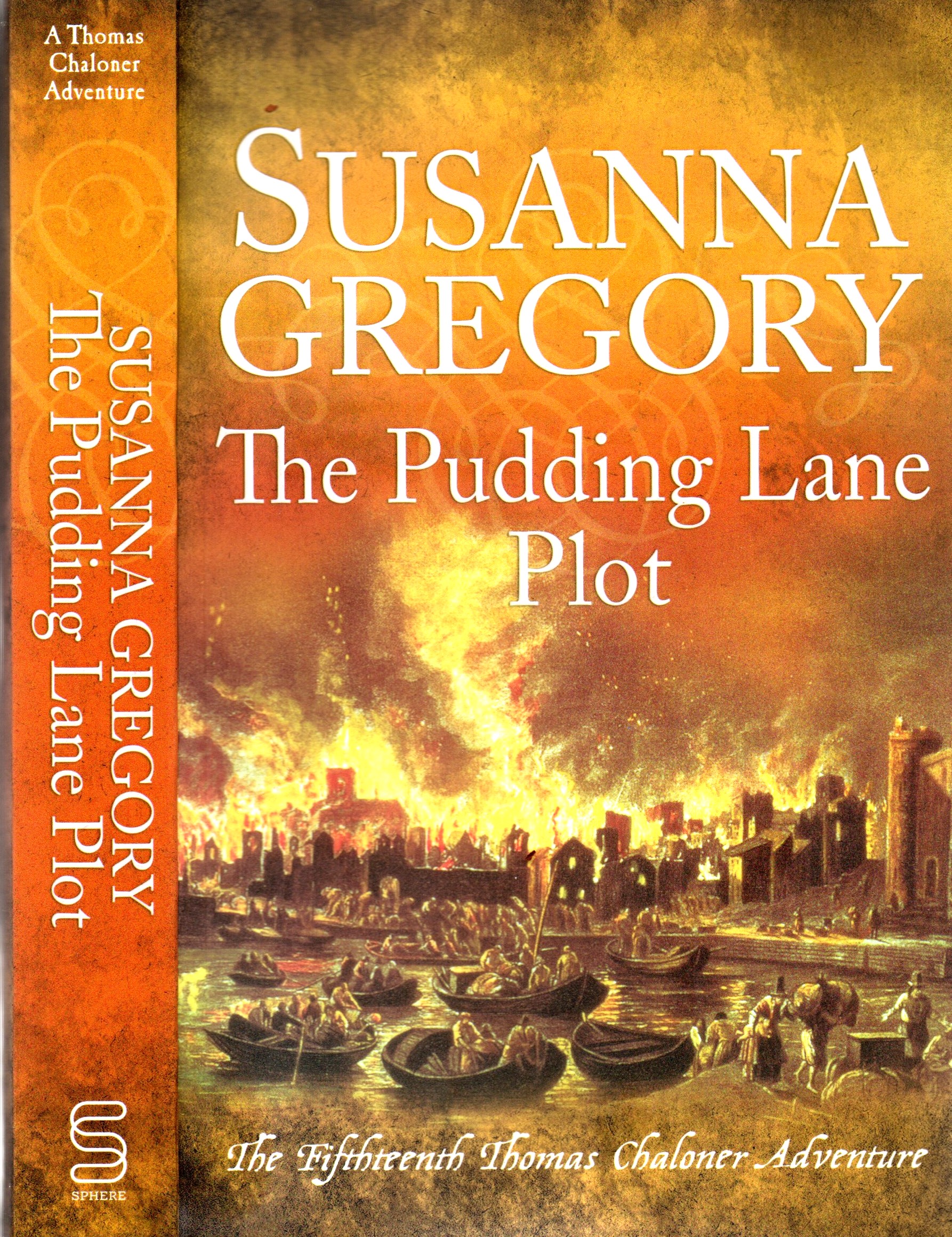
Susanna Gregory's 'The Pudding Lane Plot' 2022

Sphere paperback edition - 2023

Now that the Matthew Bartholomew series has concluded - after twenty-five books - there is only the Thomas Chaloner novels to look forward to. Matthew's exploits frankly ran out of steam and Susanna Gregory was wise to 'finish him off'. Challoner is into his fifteenth tale and has reached August 1666, only five years after the first exploit in 1662. The author must beware of the repetitious nature that befell the Bartholomew books - certainly a cut-off after 20 books should be the aim for this series. Chaloner's ungrateful master, the Earl of Clarendon, loses his position in 1667  and goes into exile. Chaloner also speaks of wishing to leave London in this book, so perhaps end-game signs are there.

After reading 40 Gregory books, I feel I can recognise her style with all its strengths and weaknesses. She clearly knows her 'onions', both for 14th century Cambridge and 17th century London. Her research, backed up by including the 'Historical Notes' at the end of each novel is detailed and impressive. Whether it adds to her tale that real people's names have been ferreted out for use, is debateable, as she has no way of knowing whether her imposed character studies are fitting. The strength lies in her undoubted ability to evoke the sights and sounds (and smells!) of 17th century London. She also does not foist on Chaloner detective abilities/foresights which are anachronistic. However, the multiplicity of characters, the two steps forward one step back by Chaloner does rather drag and can occasionally feel like padding to get to the required (?) 400 pages.

I will continue to buy the Chaloner series as they have become rather like a well-worn glove.  Steady, reliable but not particularly exciting. Whether her hero will make anything of his meeting with Dorcas in the Foxhall Pleasure Gardens, in the last pages, is another matter. Matthew Bartholomew managed to last a quarter of a century of tales before he finally succumbed, so Thomas Chaloner (admittedly twice widowed) might hang on a little longer

The one blot was the cover of the paperback (was it the same on the original hardback?) which clearly depicted the Great Fire of London at its height. It was not mentioned until the very last page and, even then, it was merely an account of the outbreak in Farriner's baker's shop in Pudding Lane.