Thursday, 20 April 2023

G.P.R. James' 'The Smuggler: A Tale' 1845


Smith, Elder and Co. first edition - 1845

G.P.R. James had taken up a house in Upper Walmer, Kent - some quarter of a mile from the sea - in the spring of 1841. Towards the end of 1843, he moved to another abode, a mile or so away, called The Oaks, close to Upper Deal Church. Here he wrote, among other novels, Agincourt and Arabella (1844) and The Smuggler (1845). I have all three in three-decker first editions, with Arabella still to read. 

When James wrote The Smuggler, reminiscences of the smuggling age were yet fresh, with many an elderly hearty ready to tell wonderful, if occasionally exaggerated, stories of bygone years.  James, ideally placed at Walmer and Upper Deal, will have heard at first hand such stories and was able to weave into his tale the exploits of the Ransley Gang (whom he styles 'Ramley'). The geographical position, its local features, its variety of coast, all afforded the county of Kent the greatest advantages - the fine level of the Marsh, Sandwich Flats and Pevensey Bay presented harbours of refuge and places of hiding for the kegs and bales. Moreover, the interior of the county - large masses of wood, numerous gentlemen's parks, hills and dales, roads only fit for horses or men on foot - offered the land smugglers the secrecy and safety no other county afforded.`

The story of Smuggling in east Kent in the 1820s is dominated by the Blues (supposedly due to them wearing blue smocks to work), who were a gang based in Aldington and who worked the area between Rye and Deal. The nucleus of the group came from that village and picked up support from a larger area. From Sandgate to Dungeness, and in every town in the Marsh there were confederates and hiding places. They were engaged constantly in conflicts with revenue officers as well as with the dragoons who finally were employed to put an end to smuggling. The cargoes were usually tobacco, spirits and salt. On arrival, the land party of 250 or so usually formed a corridor of armed men stretching about 40 yards inland. Protected by this cordon, the contraband was moved quickly.  Prominent in such smuggling was George Ransley and his family. They were from Ruckinge and were originally farmers and waggoners. Profits from smuggling paid for his house at Aldington, the unlicensed Bourne Tap. The gang were renowned for their violence. Ransley organised his business methodically and professionally. He kept a surgeon, Dr Ralph Papworth Hougham, to attend to wounded smugglers; his solicitors in Ashford, Langham and Platt, defended him when necessary in court. At Aldington, the gang used the Walnut Tree as their H.Q., but he also profited from the sale of smuggled liquor from the Bourne Tap.


Ransley's long career ended at his home 'one stormy night' (shades of G.P.R. James!) in 1826. The authorities had finally had enough. A party of preventative authorities aided by a couple of Bow Street runners encircled the house and captured Ransley (who was in bed). A further 18 smugglers were also taken. They were all sentenced to death but the punishment was reduced to transportation. 

James weaves a credible and quite exciting story into the 'factual' aspects of the time. I think it is possibly one of his best tales. Each character stands up and is 'alive'. The two 'heroes' - Sir Henry Leyton and Sir Edward Digby are well-drawn and have quite distinct personalities; as do their two 'belles' - Edith Crowland and Zara Crowland. Moreover, the author's portrayal of the latters' father, Sir Robert Crowland, is realistically developed from a weak, pathetic figure into the man who comes good at the end, dying with a modicum of peace and happiness. His sister, Mrs [sicBarbara Crowland, could equally be found in the pages of Sir Walter Scott or Jane Austen. The younger brother, Zachary Crowland, was surely drawn from someone James knew, so well-rounded does he appear: there was nothing on earth which he considered so foolish as good-nature; and he was heartily ashamed of the large portion with which Heaven had endowed him. Richard Radford Snr. and Richard Radford Jnr., are more than arch typical 'baddies', with very differentiated personalities. As for the Ramleys (James merely changed two letters), that unsavoury family appeared drawn from real life. The two boys grew up into as fine, tall, handsome, dissolute blackguards as one could wish to look upon; and for the two girls, no term perhaps can be found in the classical authors of our language...they were two strapping wenches [with] the invincible arm of their mother.

The lesser characters - Jack Harding, the Widow Clare and her daughter Kate (whose tragic end veers on the right side of pathos), and the customs officer Mr Mowle, are also realistically delineated. The story of the latter's infiltration of the smugglers' gang may well have come from the real life events surrounding the [in]famous Battle of Brookland on 11 February 1821, where 4 smugglers  were killed and 16 seriously wounded, a midshipman James McKenzie was the only blockader to lose his life. Cephas Quested mistook one of the blockade officers, who was wearing a smock as a disguise, for one of the gang. Quested put a musket in his hand and ordered him to Blow some of the ---officers' brains out. This mistake cost him his life. Only Mr Warde (later unmasked as Mr Osborn, Harry Leyton's uncle) doesn't quite ring true.

My only irritation with the novel is something that James was well known for as a writer. His all too regular musings on 'aspects of life' in general, which serve to break up the flow of the narrative and rarely add anything of real value.  The very first paragraph in Volume One compares the improvements in clocks and watches during the last half century with society, which is but a clock, a very complicated piece of mechanism... The second volume  commences: What a varying thing is the stream of life! How it sparkles and glitters! Now it bounds along its pebbly bed, sometimes in sunshine, and sometimes in shade...Now it runs like a liquid diamond along the meadow; now it plunges in fume and fury over the rock...Oh dear!

First edition title page

I also have a lovely paperback edition in the famous Routledge Railway Library Sixpenny unabridged Novels series. The illustration on the front shows a sinister smuggler with a black eye patch - the 'Major' - who recognises the disguised  Customs Officer, Mowle. However, in recalling that the latter had 'saved' him at a magistrates' hearing, he allows him eventually to escape.

George Routledge and Sons paperback edition - 1887

I also referred to some of the books on Smuggling in my Library, in particular:

1909: Charles G. Harper  - The Smugglers (Chapman & Hall)
1959: Neville Williams - Contraband Cargoes. Seven Centuries of Smuggling (Longmans, Green)
1991: Richard Platt - The Ordnance Survey Guide to Smugglers' Britain (Cassell Publishers)
1999: Tom Quinn - Smugglers' Tales (David & Charles)
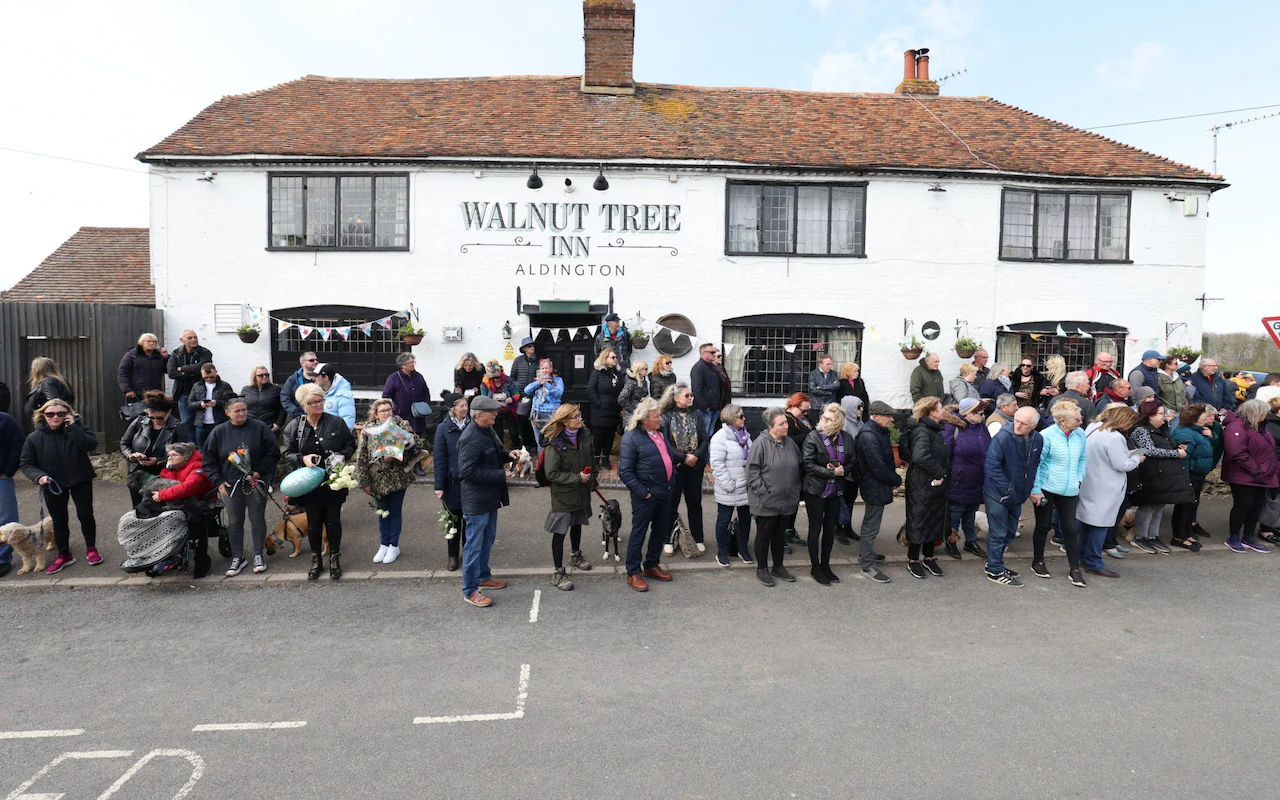

Amazingly, as I was putting the finishing touches to this Blog, I read the account of Paul O'Grady's (better known as the drag artist Lily Savage) funeral in his local village of Aldington. One of the photographs was of villagers lining the street outside none other than the Walnut Tree. I wonder how many in the crowd were descended from the Aldington Gang!

Friday, 14 April 2023

John Sweeney's 'Killer in the Kremlin' 2022

Penguin paperback first edition - 2023

What a gruesome story; what an evil man. No excuses - Putin is a narcissistic, psychopathic, sociopathic, plain evil creature. Sweeney's chapter headings chart the remorseless  path The Killing Machine - Rat Boy - Once and Future Spy - The Poisonings Begin - Mr Pleonexia (I had to look that up!) - The Underpants Poisoner - This Ends in Blood. Although this book might be regarded as a polemic, it is one that I totally subscribe to. 

John Sweeney calls himself an 'old school' reporter and says his philosophy is I poke crocodiles, if crocodiles they be, in the eye with a stick. He seems to have poked Putin in every orifice available; it's a wonder Sweeney is still alive, as his account of Putin's systematic murders/assassinations of those opposed to him stretches back to over a quarter of a century. Sweeney has gone undercover to Zimbabwe, Chechnya, twice, and North Korea. He upset Donald Trump by asking him about his links with the mob, and infuriated that sinister cult the Church of Scientology. An ideal man then for recounting Putin's unsavoury past, present and ? future.

What Sweeney has done for me, above all, is to link all those Putin involved 'episodes' together. I clearly recall reading about the bombing in Moscow in September 1999 - of two separate working-class blocks of flats - killing 222 men, women and children. Chechen terrorists? That was the official finding; more likely Putin's KGB (FSB now). Then the rash of poisonings of (sometimes potential) opponents:  Anatoly Sobchak, Putin's 'oldest friend' in politics, who died of a 'heart attack' in February 2000; Yury Shchekochikhin, a tough liberal democrat M.P., died in July 2003 due to 'toxic agents of an unknown origin'; Anna Politkovskaya, a forthright Russian journalist, gunned down by a lone assassin in her  Moscow apartment block in October 2006; Alexander 'Sasha' Litvinenko, dying in a London hospital, from drinking tea AND 26.5 microgrammes of Polonium-210; Boris Berezovsky, whose body was found by a bodyguard in a locked bathroom, with a ligature around his neck, in March 2013; Mikhail Khodorkovsky, once the richest man in Russia, sent to a Siberian labour camp; and his British lawyer Stephen Curtis, whose helicopter fell out of the sky approaching Bournemouth airport in March 2004 Worse was to come: an Air Malaysia Boeing flight MH17 over Eastern Ukraine was shot down on 17 July 2014 - by a Russian BUK surface-to-air missile. 298 people were killed. It emerged that it was downed by the Russian army. Putin, ever the narcissistic psychopath, denied involvement to Sweeney's face. The murders continued: on 27 February 2015, on a bridge one hundred yards from the Kremlin, Boris Nemstov - who nearly became leader instead of Putin and was now leader of the opposition -  was shot dead. Events came much closer home to the British, with the Salisbury poisonings of Sergei Skripal, once in the GRU Russian military intelligence, and his daughter Yulia. Sergei's 43-year-old son had already died of a 'mysterious' illness on a trip to St Petersburg in 2017. Sergei and his daughter survived but an unlucky woman, Dawn Sturgess, who ended up with a so-called perfume bottle, did not. The poison was Novichok. Then, in April, 2018 Maxim Borodin, a brilliant investigative journalist, fell off his balcony on the fifth floor of a Moscow apartment block. Official verdict - suicide. There have been several other 'falling out of a window' deaths in the last few years. And now we have that very brave (foolhardy?) opposition leader Alexei Navalny, who recovered from poison smeared on his underpants in August 2020, languishing in a Russian prison.

What rankles is that British politicians such as Peter Mandelson and George Osborne (as shadow chancellor) snuggled up to Oleg Deripaska, one of the very shady Russian businessmen. The Conservative Party certainly accepted 'Russian money' - Tories mentioned by Sweeney include John Whittingdale, Carrie  Symonds and Matthew Elliott. Boris Johnson's friendship with Evgeny Lebedev (now Baron Siberia - you couldn't make it up!), the son of a KGB colonel, is worthy of comment. Then there's Donald Trump! Sweeney writes: Was Trump the Kremlin candidate?...once in power, Trump did pretty much everything the Kremlin would have wanted him to do: sow division in NATO, weaken the European Union, kowtow to Putin.

And now (April 2023) it's the tragic plight of Ukraine and its people - being bombed to smithereens, murdered in cold blood, forcibly removed to Russia. Sweeney may be partially correct, when he calls the instigator of this inhuman crime (worthy of his predecessor Stalin) a fragile monster, but it is more blunt than that. Putin is purely a monster. Blood-soaked, evil, tyrannical, who is not fit to live.

Monday, 3 April 2023

Anthony Burton's 'William Cobbett: Englishman' 1997


Aurum Press first edition - 1997

In the middle of reading this biography, the latest Catalogue - number CCLXI - turned up from Jarndyce. These catalogues are collectors' pieces in their own right; this one was on The Romantic Background: Revolutionaries, Reactionaries, Radicals & Royals. It concentrates on items relating to the period roughly from 1790 to 1830 and, rightly, says in its Introduction, It was an extraordinarily fertile period in British literary history, and one in which writers, and poets in particular, engendered a new and more socially aware canon of writing. I looked for, and of course found, publications by and linked to William Cobbett. Items 434 to 485 relate to the man whom the compilers of the Catalogue say was a perennial thorn in the side of the establishment and who campaigned ceaselessly to expose corruption, to oppose abuses of power, and to champion the causes of the beleaguered and downtrodden. Ten other items for sale are also linked to Cobbett. I have purchased No. 472, the first edition of Cobbett's Legacy to Parsons, which queries their right to tithes etc, greater than the Dissenters have to the same? The copy will need 'work' on it, as the front board is partly detached. *

Cobbett's story is a fascinating one. As I read on, I found myself more and more impressed with his determination and staying power. He must have been nearly impossible to live with, and one's heart goes out to his long-suffering spouse Anne (Nancy). He met her in St. John, New Brunswick, where her father was an artillery sergeant. She was a tiny creature, just four feet two inches tall and only thirteen years old, but he decided at once that she should be his wife. She was beautiful, which to Cobbett was an 'indispensable qualification'. Thus, at least one good came out of Canada, which Cobbett described as 'the offal' compared with the USA which was the 'sir-loins'. That was in 1785. Back in England, they were married in 1792. She stuck the life with him until 1827, when she attempted suicide. Cobbett's relations with her never really recovered and, as he grew more paranoid in old age, they were barely on speaking terms. Tragically, on his death bed, she had to wait until he had lost consciousness before she was allowed into the room. 

Modesty was never a part of Cobbett's nature. Too true! You were right if you agreed with him; simply wrong if you disagreed. His life is littered with argument, invective, fallings-out with former allies, and rarely with magnanimity. He hated William Pitt, George Canning, and Viscount Castlereagh; despised Sir Francis Burdett (whom he saw as a turn coat); alternated between praise and scorn for Thomas Paine (he brought his body/bones back to England for reburial!); but was a cheer leader for the 'wronged' Queen Caroline. He had to escape abroad to the United States on two occasions; he was imprisoned in Newgate from 1810 to 1812 (Anne was pregnant again and debts were mounting, but she stood by him).

He was born a century too early, as few in power and authority shared his views. He increasingly saw it as his purpose on earth to be the champion for the poor - rather like Gladstone, he moved from being a reactionary to a radical, although the former never moved to the extremes that Cobbett did. Cobbett's great weapon was his ability to convey his views in print - his Rural Rides may have been his best work (the one which is probably his most known today), but from his first appearance in print - as Peter Porcupine in the United States, a stream of writing - newspapers ( the Register, Cobbett's Evening Post etc.), tracts, manuals, travel books and letters kept him at the forefront of political and social affairs. He ranted against Rotten Boroughs (Old Sarum was the accursed hill) and the Church of England and its clergy, particularly the hierarchy, homing on on the iniquity of tithe gathering. He loathed Methodists - who preached servility on earth, with the promise of rewards in heaven. He was apoplectic over Peterloo 'massacre'

One of  Burton's chapters is entitled The Angry Man - it could well sum up Cobbett's entire life! He had much to be angry about and did his best to ensure his readers knew about real poverty not just the abstract idea. He crossed literary swords with Rev. Thomas Malthus - poverty was not the end result of a natural law. It was due to particular actions taken by specific men, and these actions could be changed...he dreamed of his perfect land: he fought all his life for justice for the poor.

Another biography, which I have, by Daniel Green - which has as its subtitle The Noblest Agitator - puts on the back flap of its dust wrapper: He was  moralistic, dogmatic, pugnacious, prejudiced, scurrilous, and deeply compassionate, and as much of a humbug as any other successful agitator, for all his belief in his own absolute rectitude. Spot on!

Hodder and Stoughton first edition - 1983


I saw great Cobbett riding
The Horseman of the shires;
And his face was red with judgement
And the light of Luddite fires.
G.K. Chesterton: The Old Song

*It has gone off to my favourite, and extremely skilful, bookbinder. I look forward to reading it in a pristine state when it returns.

Thursday, 30 March 2023

Enid Huws Jones' 'Mrs. Humphry Ward' 1973


William Heinemann first edition - 1973


I already have a biography of Mrs. Humphry Ward (see Blog of 28th December, 2022) but saw this on the Internet for £5 and swooped. It is a much slighter book than John Sutherland's and it skates over certain less positive aspects of the Ward family. Both biographers acknowledge their debt to Mrs. Mary Moorman, granddaughter of Mrs. Humphry Ward, but Sutherland, writing just four years' before her death, may have  been given a freer rein. Enid Jones also paid tribute to the support of other family members. She lived in Mary Ward House, where her husband was first Principal of the National Institute for Social Work Training. I read Jones' biography on the train to and from London last week (an appalling experience - the journey not the reading). Walking from St. Pancras to the bookshops of Marchmont Street, I turned off my usual route to go down Tavistock Place to view and take photographs of the building, still a leading Conference Centre and Exhibition Venue. Mary (Mrs. Humphry) Ward would surely be proud and delighted that, 100 years' after her death, her project was alive and thriving.

In the March sunshine

Jones is capable of useful insight: The bonds of Mary Ward's life, at forty-six, were now inescapable: wife, mother, society hostess, lady of the big house, modern philanthropist, and always inexhaustibly the writer, driven surely by an inner compulsion as well as by financial need. In her self-image she was a woman of letters who spared time for good works. Yet it was through her good works, perhaps, that her more permanent creations would emerge. and did not spare her subject: A reader who finds his way today [1973]...is astonished that serious critics once admired Mrs Humphry Ward as a mistress of English prose. There is the occasional shrewd phrase, the nostalgic descriptive passage like those minor Victorian landscapes seen today in a Bond Street window, and judged 'rather nice'. Manuscripts and printed drafts are evidence of laborious revision and abridgement; didactic passages are sacrificed, whole episodes are dropped...even in her most splendid period the slovenliness of the great slogger leaves open pot-holes in the macadam of her prose. She did not write by ear...characters are built up from their social externals...Mary Ward's contemporaries liked her style; if they complained, it was of her didacticism, her characterization, and ultimately of her values.

However, one needs to go to John Sutherland for a more rounded version of Mary's life and the effect of her father's self-centredness and near-cruelty of her as a young girl - he gets off lightly in Jones' account; of her husband's sponging on her for decades, to finance his picture-buying near mania; of her son's selfish mediocrity; of her own constant battle with ill-health (sometimes psychosomatic but mostly real). 

I have a contemporary newspaper review of Jones' biography - by one Stephen Corrin. He regards it as an excellent short life, (presenting) a fascinating picture of the high-minded do-gooder (who) wrote those heavily didactic novels, all of them so solidly earnest as to "relieve their readers from any reproach of wasting their time on trifles"...her unique subject, whom she aptly describes as a "shrewd organiser of the kingdom of heaven on earth." Well, that's not a bad epitaph.

Tuesday, 28 March 2023

G.P.R. James' 'The Woodman; A Romance' 1849


T.C. Newby first edition - 1849

I have now read two of G.P.R. James' Romances in a row - and I like them! The Woodman's subtitle is The Times of Richard III and it contains pretty accurate portraits of both the Last Plantagenet and his nemesis, Henry Tudor.

Richard himself muses on his past - whose cradle was a corslet, his nursery a bloody fight, his schools Hexham, and Barnet, and Tewkesbury, his pedagogues York, and Salisbury, and Warwick and Edward.
James follows the traditional charges levied at Richard. He has Bishop Morton telling Iola, now the hatred of the reigning king has pursued me, because he knew right well, that I would raise my voice against the wrong he did his brother's children; and, much later in the novel, will you Chartley, even for the hand of Iola, become the labouring, straining serf of him who slew your royal master's children, slaughtered innocent babes, spilt the blood of his own house?

The author adds his own summary of the monarch. ...as great a man perhaps as a bad man can ever be. He was mighty as a soldier, mighty as a politician, almost sublime in the vast wide-stretching reach of his subtlety. Through life he had played a game almost against all odds; and he had won every stake. He had seen those, who stood between him and the light, swept away; he had contrived to remove obstacle after obstacle; he had crushed or aided to crush all the enemies of his house; he had imposed the silence of death, or the chains of exile, upon all personal opponents...because he was ambitious, and all things gave place to ambition, we have no right to conclude that his heart was without feelings even of a gentle and a kindly nature. Ambition was the idol; and to it the heart sacrificed its children. James gets across the heartbreak for Richard and Queen Anne over the loss of their son Edward; but he also dissects Richard's ruthless plan to marry his niece Elizabeth once he realises his wife is mortally ill - we must foresee events, Ratcliffe.

Henry Tudor is also realistically (and accurately?) portrayed. Morton communes with himself in exile: better a cold and greedy prince upon the throne, than a murdering usurper... James realistically describes the treacherous background within which Tudor struggles in both Brittany and France and the calculating character of the exile, but who can also show kindness when it does not harm his self-interest.

Edward IV is also summed up well (through the mouth of the Woodman): a man of many high qualities, and also of many great vices; brave, courteous, graceful, and good-humoured; lewd, idle, insincere, and cruel; a consummate general, a short seeing statesman, a bad king, a heartless kinsman, a man of pleasant converse, and a devoted friend. Not a bad summary.

Lord Stanley is sympathetically drawn, as are several other characters, such as the Lady Abbess of Atherston, the merriest little abbess in the world; only the fictitious Lord Fulmer comes across as a first-class rotter, as does the slimy Sir Charles Weinants. Sam the piper, the injured ex-soldier plying his trade for sustenance; Ibn Ayoub, the Arab servant of Lord Chartley; Sir William Arden, Chartley's closest buddy; and Sir Edward Hungerford, a foppish character, like a kingfisher, you are better known by your feathers than your voice; all stand up to reality's scrutiny.

Much of the action takes place in the area around Atherstone and Tamworth; thus, it is conveniently near the denouement on the field of Bosworth. James starts his chapter on the battle by writing, Shakespeare made a mistake (about the weather!); but he, too, gets one thing wrong, when he writes the whole force of Richmond moved down the hill - Henry's forces fought on flat ground.

James allows several shafts against the late medieval Roman Catholic Churchperhaps there have been few ages in the world's history, more grossly superstitious than those which immediately preceded the reformation. The process of darkening the human mind, in which alone the errors of the church of Rome can be maintained, had been going on for so many centuries, that it had almost reached completeness...in England especially, every false, abominable, and idolatrous dogma was more sternly and clearly defined, in order to prevent the escape of the Wicliffites through any ambiguity of language. One could almost think this was Sir Walter Scott or Thomas Gaspey, or me for that matter!, writing such lines. In fact, both the heroine Iola, her close companion Constance and, potentially, the hero Lord Chartley (whose uncle, a previous Lord Chartley, fought for Lancaster at Barnet and was killed there), subscribe to the late Lollard movement. Iola attends a secret meeting of a group of some thirty Lollards near Tamworth and Sam the piper describes it to the Woodman: where the songs seemed pure and holy; for ever and anon, they praised God's name and gave him honour and glory. They prayed too, but in the English tongue...and, though people, no doubt, would call the meeting Lollardy, I liked it well.

There are a few loose ends, inevitable in a rather rushed final chapter. Do Sir William Arden (saved by the bell at Bosworth from Richard's decreed beheading!) and Constance marry? The gruff old soldier deserved the bride he had wooed from the first, although he was caught upon the road, stealing a nun (Constance) from a convent...! However, to be fair, it concentrates on the person holding the title of the three volumes - the 'Woodman', who proves to be far more important than one of that trade. I guessed who he was as soon as a titled lady came looking...


I am by no means a literary critic, but I feel that Sir Walter Scott would not have been ashamed to have written The Woodman. If James had taken one of his publisher's advice and written just half of his output, perhaps he would have ranked higher in a posthumous pantheon. Robert Louis Stevenson, Thomas Hardy (who recalled them with pleasure), Walter Savage Landor, Allan Cunningham, even Thackeray towards the end of his life, all praised and enjoyed reading James' novels. Sir Walter Scott and Washington Irving encouraged James' earliest work, as did John Wilson ('Christopher North'). He also has another admirer in me - and I shall read more of him soon! 

A final thought - from G.P.R. James - The grave of a woman's first life is her marriage contract. One could say the same about men's!

Friday, 24 March 2023

G.P.R. James' 'Agincourt; A Romance' 1844


Richard Bentley first edition - 1844

George Payne Rainsford James (1799 or 1801! - 1860), usually known as G.P.R. James, produced nearly 100 works between 1828 and 1859. Scarcely a year went by that he failed to produce at least one novel, most of them three-deckers. This excessive production was fatal to his permanent reputation, but to his contemporaries he remained a popular writer. So famous was he for his literary proclivity that in The Comic Times of 31st August 1850, the following pasquins appeared:

BIRTHS.
"On the 7th, Mr. G.P.R. James of his 136th offspring. The little stranger, which is a tripod, we are sorry to say, is not doing very well."
ADVERTISEMENTS.
"Mr. Newby begs to announce the following new work in the press:
In Three Volumes.
The Old Oak Chest (made out of his own head),
by G.P.R. James, Esq." 

Rather cruel; but it must be admitted (like Sir Walter) the author should have been subjected to severe pruning. Once again, it was the result of the three-decker requirements. There is an equally uneven biography of James - The Solitary Horseman by S.M. Ellis (The Cayme Press, 1927), published in a limited edition of 800 copies. Ellis started to write it in 1912, but various difficulties, including the War, caused it to be laid aside... I have a copy and the biographer certainly details the main thread of James' life, but has very little to say about the books themselves, or their quality. 

Inevitably James was baited in Punch, but not as often as Bulwer Lytton or Ainsworth. The humorists included Thackeray - And what Briton can read without enjoyment the works of James, so admirable for terseness. Another satirist put a series of questions to James, which ended, How long do you intend to keep on writing such stuff? The author could well have replied: As long as the public pays me to do so... for he usually received £500 or more for each of his romances. 

I have quite a few of G.P.R. James' works:
Novels in First Edition:
1838:    The Robber (3 vols) 
1844:    Agincourt (3 vols.)
1844:    Arabella Stuart (3 vols.)
1845:    The Smuggler (3 vols.)
1848:    Gowrie
1849:    The Woodman (3 vols.) 
also
The Works of G.P.R. James:
1844:    Vol. II        Mary of Burgundy
1845:    Vol. III       The Huguenot
1847:    Vol. XIV    Forest Days
1848:    Vol. XVI    De L'Orme
1848:    Vol. XVII   Gowrie
1849:    Vol. XXI    Castelnau
Harper & Brothers:
1857:    Leonora D'Orco
1858:    Peqinillo: A Tale
1858:    Agnes Sorel. A Novel
Routledge's Sixpenny Series:
1882:    The Brigand or Corse de Leon
1887:    The Smuggler
Non-Fiction in First Edition:
1830:    The History of Chivalry
1836:    A History of the Life of Edward the Black Prince (2 vols.)-0


I read The Smuggler some years ago and have just bought the novel in its three-decker first edition - I will be returning to it soon. But, first I thought I would read Agincourt and then The Woodman. Rather like Major Michel's Henry of Monmouth, the actual battle takes up a tiny portion of the Tale. It commences in true Jamesian style with a dark night, a lonely road, woods and streams, and two travellers. Ellis entitled his biography of James, The Solitary Horseman. Thackeray it was who really branded this literary trade-mark upon James in his burlesque, Barbazure, By G.P.R. Jeames, Esq., etc. In six of James' 57 romances, "a solitary horseman" appears in the first chapter and in two others he delays his arrival until the second; "two cavaliers" caracole in the first chapters of three books and in the second of another. James seems to have taken Thackeray's satire to heart, as in the twenty or more stories he wrote afterwards there is ne'er a sign of horsemen at the start!

The two Agincourt riders play pivotal roles in the story. The first introduces himself to the other as Hal of Hadnock, who turns out to be Prince Hal on his way to his sick father, Henry IV, in London. The second, is Richard of Woodville, the hero of the story. The story has shades of Ivanhoe every so often - the old hall at Dunbury (Rotherwood), the tall powerful old man, Sir Philip Beauchamp (Cedric), Isabel Beauchamp  (Rowena/Rebecca) whose hair was as black as jet, her skin soft and clear...her eyes were of a deep clear blue...with long fingers tapering to a point, showed in every line the high Norman blood of her race. In addition there is a fascinating, wilful cousin, Catherine Beauchamp who is also destined to play an integral part in the plot. She is murdered not far into Volume One - or is she?! There is the inevitable baddie - Simeon of Roydon, a distant cousin, whose smooth exterior was but a shell containing a less pleasant core...there was an occasional quiver of the lower lip, as if words which might be dangerous were restrained with difficulty...In addition, there is Sir Henry Dacre, who is betrothed to Catherine but really loves Isabella; Richard of Woodville loves Mary Markham (her surname is yet another 'disguise'), the third woman in the hall. Are you following?

The story moves from Dunbury to London, to Burgundy and then to France. It takes on board other well-rounded characters - Sir Philip de Morgan, England's representative in Ghent; Sir John Grey, exiled under Henry IV, and father to Mary 'Markham', who takes his time in accepting Richard of Woodville as a potential son-in-law; the Count of Charolois and his father, the Duke of Burgundy, also figure in the tale. Ella Brune, whose father is killed by Simeon of Roydon's horse and who is helped by Richard of Woodville, becomes fiercely attached (in love with) the latter - again, shades of Rebecca and Ivanhoe? It is thanks to her that Richard survives more than one 'scrape'. Ned Dyram, a servant foisted on Richard by King Henry V, proves an absolute rotter (he ruthlessly pursues Ella) and inevitably links up with Simeon to try and destroy Richard.. 

There are glimpses of humour. Near the fine chaste cross at Charing, - which stood hard by the spot where the grand libel upon British taste, called Trafalgar Square, now stands...

Yes, James loves to dwell on descriptions of nature and the dress of the period; like Scott and others of the 19th century, he takes a paragraph when a couple of sentences would do and far too unlikely coincidences help the plot along. But I find him a good companion of a winter evening and am already engaged in The Woodman.

Wednesday, 8 March 2023

Thomas Gaspey's 'The Lollards' 1822


Longman, Hurst, Rees, Orme, and Brown
first edition - 1822

This three-decker was published anonymously, but the title pages gave clues as to the author, by listing his previous works: The Mystery, or Forty Years ago and Calthorpe, or Fallen Fortunes. Those in the know would have pointed to Thomas Gaspey (1788-1871) as the progenitor. 

Gaspey was a Parliamentary reporter on the Morning Post, where he also contributed dramatic reviews and reports on treason trials. He stayed with the newspaper for sixteen years before becoming a sub-editor at the Courier, a government paper. In 1828 he bought a share in the Sunday Times, where he raised it as a literary and dramatic organ. He died, aged 83, at his home at Shooter's Hill. Two of his sons were also involved in literary works. Gaspey was again to write on Lord Cobham - who played a vital role in this novel - when he published The Life and Times of the Good Lord Cobham (1843)

The Preface is useful, as it gives the reader the authorial intention: The author, - the compiler, perhaps, he should rather call himself, has supplied from imagination what he considered necessary to give them [correct scenes]  connexion; but generally he has kept as closely as possible to history. Gaspey then went on to reveal his sources - Maitland, Pennant, Malcolm, Douce, Henry, Beckmann, Baker, Monstrelet, Hollingshed, and Grose (I have only heard of three of them) - are responsible for most of the historical facts and local representations. The author also explains why he thinks there were printed works around as early as 1415.

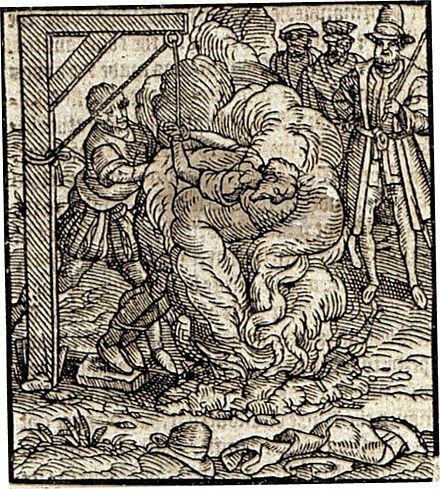
I am very partial to John Wycliffe and the Lollards for several reasons. One can trace a journey over the centuries to Methodism; Lutterworth is not far from Ashby de la Zouch and my semi-adopted area of England; and I admire his/their role is highlighting and castigating the malign influence of the Roman Catholic Church in medieval times. Gaspey sets the scene well - in fact, the first piece of dialogue does not occur until page 41 in Volume I. He gives us not only a compelling account/appraisal of Oldcastle (Lord Cobham) but also of the recently appointed (1414) Archbishop of Canterbury - Henry Chicheley (c.1364-1443). The latter, portrayed as a fierce opponent of Lollardy and intimately involved in the death by burning of Cobham on 14 December 1417, is also given a few scruples. At least the latter makes it to page 138 of the final volume. 

Oldcastle being burnt for heresy

The story follows the fictitious sons of Oldcastle and Lord Charlton of Powys (1370-1421), who was responsible for capturing the former on his estates in Herefordshire and who was able to claim a hefty reward, much to the chagrin of his 'son'.  Scenes are set in Prague and Constance, where Jan Hus is tried, condemned and burnt, much to the horror of Oldcastle's 'son' and 'daughter'. Once again, the reader gets the feeling that the story was 'stretched' rather to fit the requirements of the [in]famous three-decker, and there are various meanderings in both England and France, before true love for most of the characters ends happily. This includes King Henry V, who is again portrayed sensitively ( his shock at seeing Catherine of France's beauty is well described!) It was unusual to read of Agincourt, that the scene was set after the battle and vibrantly described the carnage and suffering - arms, legs and heads were scattered in every direction, in frightful confusion. One feels the regular descriptions of the London streets and buildings could, perhaps, have been cut. 

So, Edward and Alice Oldcastle; Matilda and Sir Thomas Venables; Octavius, son of Lord Powys; Eugene De Marle, Madam D'Aumont and Baron de Chlume wend their fictitious way through the actualité of 1413 to 1417, occasionally helped by extremely unlikely coincidences, and quite skilfully guided by the author. At least William Whittington M.P., the elder brother of the famous Sir Richard ('Dick') was really who the author says he was!

There was one nice touch of black humour, which is worth repeating: ...Holywell, they took their way to the far-famed spring said to have been furnished by the intrepid virtue of St. Winifred, whose sanctified career, according to the legend, was not to be terminated even by the process of beheading, which in other cases has furnished a very efficient check to the finest enthusiasm.